 |
 |
 |
 |
 |
 |
 |
 |
THE PORTUGUESE IN SOUTH AFRICA FROM 1505 TO 1700 .CHAPTER IX.DISCOVERY OF AN OCEAN ROUTE TO INDIA.
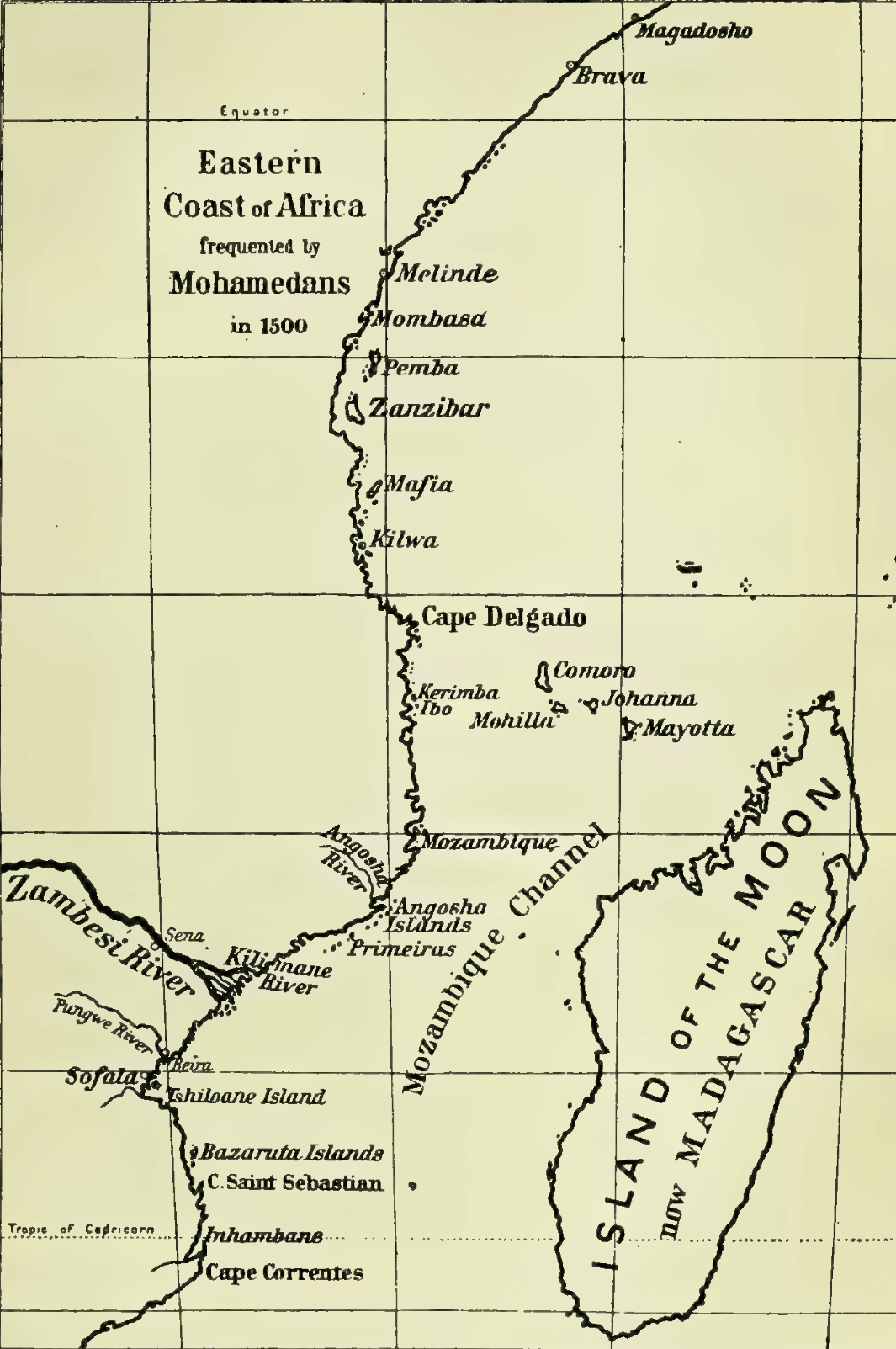
The discovery of an ocean route from Europe to India, followed by the establishment of the Portuguese as the pre- ponderating power in the East, is one of the greatest events in the history of the world. It is not too much to say that every state of Central and Western Europe was affected by it. The time was critical, for the Turks were then menacing Christendom, and if they had secured a monopoly of the Indian trade their wealth and strength would have been so augmented that it is doubtful whether they might not have succeeded in entering Vienna in 1529. As yet the Moslem power was divided, for Egypt was still under the Mameluke rulers, and the greater portion of the Indian products that found their way to Europe was obtained by the Venetians at Alexandria. To that city they were conveyed in boats down the Nile from Cairo, after being carried by camels from the shore of the Red sea, whither they were brought by ships from the coast of Malabar. From this traffic Alexandria had thriven greatly, and from it too Venice, — whose citizens distributed over Europe the silk and cotton fabrics, pepper, and spices of the East, — had become wealthy and powerful. That portion of the Indian merchandise which was brought overland by caravans from the Persian gulf to the Mediterranean coast was under the control of the Turks, and a few years later, when in 1517 the sultan Selim overthrew the Mamelukes and made Egypt a province of his dominions, the whole would have been theirs if the Portuguese had not just in time forestalled them. In the early years of the fifteenth century the Christian nations were little acquainted with distant countries, America and Australia were entirely unknown, Eastern Asia was very imperfectly laid down on the maps, and the greater part of Africa had never been explored. This continent might have terminated north of the equator, for anything that the most learned men in Europe knew to the contrary. The Portu- guese were at this time the most adventurous seamen of the world, and they were the first to attempt to discover an ocean highway round Africa to the East. Under direction of a justly celebrated prince of their royal family, Henrique by name, — known to us as Henry the Navigator — fleets were fitted out which gradually crept down the western coast until the shores of Senegambia were reached. In 1434 Cape Bojador was passed for the first time, in 1441 Cape Blanco was seen by Europeans, and in 1445 Cape Verde was rounded by Diniz Dias. Then, until after the death of Prince Henrique — 13th of November 1460 — discovery practically ceased. The lucrative slave trade occupied the minds of the sea captains, and ships freighted with negroes taken captive in raids, or purchased from conquering chiefs, frequently entered the harbours of Portugal. The commerce in human flesh was regarded as highly meritorious, because it brought heathens to a knowledge of Christianity. But never has a mistake or a crime led to more disastrous results, for to the intro- duction of negroes as labourers in the southern provinces of Portugal the decline of the kingdom in power and importance is mainly due. The exploring expeditions which Prince Henrique never ceased to encourage, but which the greed of those who were in his service had turned into slave hunting vo}Tages, were resumed after his death. In 1461 the coast of the present republic of Liberia was reached, and in 1471 the equator was crossed. King Joao II, who ascended the throne in 1481, was as resolute as his grand-uncle the Navigator in endeavouring to discover an ocean road to India. He had not indeed any idea of the great consequences that would follow, his object being simply to divert the eastern trade from Venice to Lisbon, which would be effected if an unbroken sea route could be found. In 1484 he sent out a fleet under Diogo Cam, which reached the mouth of the Congo, and in the following year the same officer made a greater advance than any previous explorer could boast of, for he pushed on southward as far as Cape Cross, where the marble pillar which he set up to mark the extent of his voyage remained standing more than four hundred years. The next expedition sent in the same direction solved the secret concerning the extent of the African continent. It was under the chief command of an officer named Bartholomeu Dias, of whose previous career unfortunately nothing can now be ascertained except that he was a gentleman of the king's household and receiver of customs at Lisbon when the appointment was conferred upon him, and that he had at some former time taken part in exploring the coast. At the end of August 1486 he sailed from the Tagus with two vessels of about fifty tons each, according to the Portuguese measurement of the time, though they would probably be rated much higher now. He had also a small storeship with him, for previous expeditions had often been obliged to turn back from want of food. The officers who were to serve under him were carefully selected, and were skilful in their professions. They were : — Leitao (probably a nickname) sailing master, and Pedro dAlanquer pilot of the flag ship; Joao Infante captain, Joao Grego sailing master, and Alvaro Martins pilot of the Sao Pantaleao ; and Pedro Dias, brother of the commodore, captain, Joao Alves sailing master, and Joao de Santiago pilot of the storeship. On board the squadron were four negresses — convicts — from the coast of Guinea, who were to be set ashore at different places to make discoveries and report to the next white men they should see. This was a common practice at the time, the persons selected being criminals under sentence of death, who were glad to escape immediate execution by risking anything that might befal them in an unknown and barbarous country. In this instance women were chosen, as it was considered likely they would be protected by the natives. It was hoped that through their means a powerful Christian prince called Prester John, who was believed to reside in the interior, might come to learn of the greatness of the Portuguese monarchy and that efforts were being made to reach him, so that he might send messengers to the coast to communicate with the explorers. King Joao and his courtiers believed that if this mythical Prester John could but be found, he would point out the way to India. Voyage of Bartholomeu Dias. Dias, like all preceding explorers, kept close to the coast on his way southward. Somewhere near the equator he left the storeship with nine men to look after her, and then continued his course until he reached an inlet or small harbour with a group of islets at its entrance, the one now called Angra Pequena or Little Bay, but which he named Angra dos Ilheos, the Bay of the Islets. The latitude was believed to be 24° S., but in reality it was 26J°, so imperfect were the means then known for determining it. There he cast anchor, and for the first time Christian men trod the soil of Africa south of the tropic. A more desolate place than that on which the weary seamen landed could hardly be, and no mention is made by the early Portuguese historians of any sign of human life being observed as far as the explorers wandered. Un- fortunately the original journal or log-book of the expedition has long since disappeared, so that much that would be intensely interesting now can never be known. But this is certain, that refreshment there could have been none, except fish and the eggs and flesh of sea-fowl that made their nests on the islets. It was no place in which to tarry long. Before he left, Dias set up a marble cross some two metres or so in height, on an eminence that he named Serra Parda, the Grey Mountain, as a token that he had taken possession of the country for his king. For more than three hundred years that cross stood there above the dreary waste, just as the brave Portuguese explorer erected it. The place where it stood so long is called Pedestal Point. Here one of the negresses was left, almost certainly to perish, when the expedition moved onward. From Angra Pequena Dias tried to keep the land in sight, but as it was the season of the south-east winds, which were contrary, he could not make rapid progress. At length by repeatedly tacking he reached an inlet to which he gave the name Angra das Voltas, the Bay of the Turnings. There is a curve in the land in the position indicated, 29° S., but the latitudes given are not to be depended upon, and the expedi- tion may have been far from it and farther still from the point at the mouth of the Orange river called by modern geographers Cape Voltas, in remembrance of that event. At Angra das Voltas, wherever it was, Dias remained five days, as the weather was unfavourable for sailing, and before he left another of the negresses was set on shore. After making sail again heavy weather was encountered and a boisterous sea, such as ships often experience in that part of the ocean, and which is caused by the cold Antarctic current being slightly deflected by some means from its usual course and striking the hot Mozambique current at a right angle off the Cape of Good Hope. Very miserable Dias and his companions must have been in their tiny vessels among the tremendous billows, with the sails close reefed, and hardly a hope of escape from being lost. But after thirteen days the weather moderated, and then they steered eastward, expecting soon to see the coast again. For several days they sailed in this direction, but as no land appeared Dias concluded that he must have passed the extremity of the continent. It was so, for on turning to the north he reached the shore at an inlet which he named Angra dos Vaqueiros, the bay of the Herdsmen, on account of the numerous droves of cattle which he saw grazing on its shores. It was probably the same inlet that was named by the next expedition the Watering Place of Sao Bras, and which since 1601 has been known as Mossel Bay. The inhabitants gazed with astonishment upon the strange apparition coming over the sea, and then fled inland with their cattle, so that it was not found possible to have any intercourse with the wild people. Thus no information con- cerning the inhabitants of the South African coast, except that they had domestic cattle in their possession, was obtained by this expedition. How long Dias remained at Angra dos Vaqueiros is not known, but his vessels, good sea-boats as they had proved to be, must have needed some refitting, so he was probably there several days at least. He and his officers were in high spirits, as, unless they were in another deep bay like the gulf of Guinea, they had solved the question of a sea route to India. As far as their eyes could reach, the shore stretched east and west, so, sailing again, they continued along it until they came to an uninhabited islet in latitude 33'3/4 S. This islet is in Algoa Bay as now termed — the Bahia da Lagoa of the Portuguese after the middle of the sixteenth century, — and still bears in the French form of St. Croix the name Ilheo da Santa Cruz, the islet of the Holy Cross, which he gave it on account of the pillar bearing a cross and the arms of Portugal which he erected upon it. Dias visited the mainland, where he observed two women gathering shellfish, who were left unmolested, as the king had issued instructions that no cause of offence should bo given to the inhabitants of any countries discovered. Here the last of the negresses was set ashore, as one had died on the passage. The coast was examined some distance to the eastward, and to a prominent rock upon it the name Penedo das Fontes, the Rock of the Fountains, was given by some of the people, because two springs of water were found there. Here the seamen protested against going farther. They complained that their supply of food was running short, and the storeship was far behind, so that there was danger of perishing from hunger. They thought they had surely done sufficient in one voyage, for they were two thousand six hundred kilometres beyond the terminus of the pre- ceding expedition, and no one had ever taken such tidings to Portugal as they would carry back. Further, from the trending of the coast it was evident there must be some great headland behind them, and therefore they were of opinion it would be better to turn about and look for it. One can hardly blame them for their protest, considering the fatigue and peril they had gone through and the wretchedly uncomfortable life they must have been leading. Dias, after hearing these statements, took the officers and some of the principal seamen on shore, where he administered an oath to them, after which he asked their opinion as to what was the best course to pursue for the service of the king. They replied with one voice, to return home, where- upon be caused them to sign a document to that effect. He then begged of them to continue only two or three days' sail farther, and promised that if they should find nothing within that time to encourage them to proceed on an easterly course, he would put about. The crews consented, but in the time agreed upon they advanced only to the mouth of a river to which the commander gave the name Infante, owing to Joao Infante, captain of the Sao Pantaleao, being the first to leap ashore. The river was probably the Fish, but may have been either the Kowie or the Keiskama as known to us. Its mouth was stated to be twenty-five leagues from the islet of the Cross, and to be in latitude 32'2/3° S., which was very incorrect. But now, notwithstanding this error, there should have been no doubt in any mind that they had reached the end of the southern seaboard, which in a distance of over nine hundred kilometres does not vary a hundred and seventy kilometres in latitude. The coast before them trended away to the north-east in a bold, clear line, free of the haze that almost always hung over the western shore. And down it, only a short distance from the land, flowed a swift ocean current many degrees warmer than the water on either side, and revealing itself even to a careless eye by its deeper blue. That current could only come from a heated sea in the north, and so they might have known that the eastern side of Africa had surely been reached. Whether the explorers observed these signs the Portuguese writers who recorded their deeds do not inform us, but from the river Infante the expedition turned back. At Santa Cruz Dias landed again, and bade farewell to the cross which he had set up there with as much sorrow as if he was parting with a son banished for life. In returning, the great headland was discovered, to which the commander gave the name Cabo Tormentoso — the Stormy Cape — afterwards changed by the king to Cabo de Boa EsperanÇa — Cape of Good Hope — owing to the fair prospect which he could now entertain of India being at last reached by this route. What particular part of the peninsula Dias landed upon is unknown, but somewhere upon it he set up another of the marble pillars he had brought from Portugal, to which he gave the name Sao Philippe. The country about it he did not explore, as his provisions were so scanty that he was anxious to get away. Keeping along the coast, after nine months' absence the storeship was rejoined, when only three men were found on board of her, and of these, one, Fernao ColaÇa by name, died of joy upon seeing his countrymen again. The other six had been murdered by negroes with whom they were trading. Having replenished his stock of provisions, Dias set fire to the storeship, as she was in need of refitting and he had not men to work her ; and then sailed to Prince's Island in the bight of Biafra, where he found some Portuguese in distress. A gentleman of the king's household, named Duarte Pacheco, had been sent to explore the rivers on that part of the coast, but had lost his vessel, and was then lying ill at the island with part of the crew who had escaped from the wreck. Dias took them all on board, and, pursuing his course in a north-westerly direction, touched at a river where trade was carried on, and also at the fort of Sao Jorge da Mina, an established Portuguese factory, of which Joao Fogaca was then commander. Here he took charge of the gold that had been collected, after which he proceeded on his way to Lisbon, where he arrived in December 1487, sixteen months and seventeen days from the time of his setting out. No other dates than those mentioned are given by the early Portuguese historians, thus the exact time of the discovery of the Cape of Good Hope and the coast onward to the mouth of the Infante river is doubtful, and it can only be stated as having occurred in the early months of 1487. The voyage surely was a memorable one, and nothing but regret can be expressed that more of its details cannot be recovered. Of the three pillars set up by Dias, two — those of the Holy Cross and Sao Philippe — disappeared, no one has ever been able to ascertain when or how ; that of Sao Thiago at Angra Pequena remained where it was placed until it was broken down by some unknown vandals in the nineteenth century. Travels of Affonso de Paiva and Joao Pires Meantime the king sent two men named Affonso de Paiva, of Castelbranco, and Joao Pires, of Covilhao, in another direction to search for Prester John. For this purpose they left Santarem on the 7th of May 1487, and, being well provided with money, they proceeded first to Naples, then to the island of Rhodes, and thence to Alexandria. They were both conversant with the Arabic language, and had no difficulty in passing for Moors. At Alexandria they were detained some time by illness, but upon recover- ing they proceeded to Cairo, and thence in the disguise of merchants to Tor, Suakin, and Aden. Here they separated, Affonso de Paiva having resolved to visit Abyssinia' to ascertain if the monarch of that country was not the potentate they were in search of, and Joao Pires taking passage in a vessel bound to Cananor on the Malabar coast. They arranged, however, to meet again in Cairo at a time fixed upon. Joao Pires reached Cananor in safety, and went down the coast as far as Calicut, after which he proceeded upwards to Goa. Here he embarked in a vessel bound to Sofala, and having visited that port, he returned to Aden, and at the time appointed was back in Cairo, where he learned that Affonso de Paiva had died not long before. At Cairo he found two Portuguese Jews, Rabbi Habrao, of Beja, and Josepe, a shoemaker of Lamego. Josepe bad been in Bagdad, on the Euphrates, some years previously, and had there heard of Ormuz, at the mouth of the Persian gulf, and of its being1 the warehouse of the Indian trade and the point of departure for caravans to Aleppo and Damascus. He had returned to Portugal and informed the king of what he had learned, who thereupon sent him and Habrao with letters of instruction to Affonso de Paiva and Joao Pires, directing tbem if they had not already found Prester John, to proceed to Ormuz and gather all the information they could there. Upon receiving this order Joao Pires drew up an account of what he had seen and learned in India and on the African coast, which he gave to Josepe to convey to the king, and taking Habrao with him, he proceeded to Aden and thence to Ormuz. From Ormuz Habrao set out with a caravan for Aleppo on his way back to Portugal with a duplicate of the narrative sent to the king by Josepe. None of the early Portuguese historians who had access to the records of the country ever saw this narrative, so that probably neither of the Jews lived to deliver his charge. Not a single date is given in the early accounts of this journey, except that of the departure from Santarem, which De Goes fixes as May 1486 and Castanheda and De Barros as the 7th of May 1487. There is no trace of any knowledge in Portugal of the commerce of Sofala before the return of Vasco da Gama in 1499, but as such a journey as that described must in the fifteenth century have occupied several years, it is just possible that Josepe or Habrao reached Lisbon after that date. Joao Pires went from Ormuz by way of Aden to Abyssinia, where he was well received by the ruler of that country. Here, after all his wanderings he found a home, for as he was not permitted to leave again, he married and had children, living upon property given to him by the government. In 1515 Dom Rodrigo de Lima arrived in Abyssinia as ambassador of the king of Portugal, and found him still alive. With the embassy was a priest, Francisco Alvares by name, who wrote an account of the mission and of the statement made to him by Joao Pires, and also gave such information on his return home as enabled the Portuguese historians to place on record the above details. As far as actual result in increase of geographical knowledge is concerned, this expedition of Affonso de Paiva and Joao Pires, of Covilhao, therefore effected nothing. Upon the return of Dias to Portugal with information that he had discovered the southern extremity of Africa and found an open sea stretching away to the eastward from the farthest point he had reached, King Joao II resolved to send another expedition to follow up the grand pathway of ex- ploration which now offered so fair a prospect of an ocean route to India being found at last. But at that time things were not done as quickly as now, and there was besides much else to occupy the monarch's attention. The outlay too would be considerable, as ships would have to be built specially to withstand the stormy seas off the Cape of Good Hope, and the kingdom was then by no means wealthy. Orders, however, were given to the chief huntsman, Joao d Braganca, to collect the necessary timber, and by the yea 1494 it was ready at Lisbon. Whether anything furthe was done towards the construction of the vessels before th death of the king, which took place at Alvor on the 25th o October 1495, is not certain ; but probably some progres had been made, as a commander in chief of the intende expedition was selected in the person of Estevao da Gama, chief alcaide of the town of Sinis. Preparations for another Voyage. King Joao II having no legitimate son, was succeeded by his first cousin Dom Manuel, duke of Beja, who possessed a full measure of that fondness for prosecuting maritime discoveries which for three-quarters of a century had distinguished the princes of Portugal. Within a year of his accession the subject of making another attempt to reach India by sea was mooted at several general councils held at New Montemor, but met with strong opposition. There were those who urged that Portugal was not strong enough to conquer and keep possession of such a distant country should it be reached, that too much public treasure had already been thrown away in fitting out exploring ships, that no adequate return had yet been made, and that even if a route to India should be opened, it would only bring powerful rivals into the field at least to share its commerce. Those of the nobles, however, who were anxious to please the king favoured the design, and at length it was resolved to send out another expedition. Accordingly under direction of Bartholomeu Dias two ships were built with the timber that was ready, his experience enabling him to point out where they required special strengthening. Very clumsy indeed they would be considered now, with their bluff bows like the breast of a duck, broad square sterns, lofty poops and forecastles, low waists, and great length of beam ; but they were staunch sea boats, capable of receiving without damage the buffeting of the furious waves they were intended to encounter. The larger of the two, named the Sao Gabriel, was rated as of one hundred and twenty tons, and the smaller, named the Sao Rafael, as of one hundred ; but a Portuguese ton of that period, as has already been observed, was probably much larger than an English ton of our times, and from their build they would be able to carry a great deal more than their registered capacity would denote. They were fitted with three masts, the fore and main each carrying two square sails, and the mizen a lateen projecting far over the stern. Under the bowsprit, the outer end of which was so greatly elevated that it was almost like a fourth mast, was a square spritsail, which completed the spread of canvas. Jibs and staysails there were none, nor anything but a flag above the topsail yards. Such was the build and rig of vessels from which the graceful barques of our time have been evolved. To accompany these ships a stout caravel was purchased from a man named Berrio, whose name it bore. A storeship of two hundred tons burden was also purchased by the king from one Ayres Correa, of Lisbon, so that a supply of provisions sufficient for three years might be taken by the expedition. Spare spars, sails, and rigging were placed on board the ships, as also samples of various kinds of merchandise and many articles that could be used for presentation to such potentates as might be found. In all respects the fleet was thus as well fitted out as was possible at that period. When all was ready the vessels dropped clown the Tagus to Rastello and anchored in front of Belem, with a caravel under command of Bartholomeu Dias, which was to accom- pany them to the Cape Verde islands, and after seeing them on their course in safety, proceed to Sao Jorge da Mina. Voyage of Vasco da Gama. Estevao da Gama was now dead, so King Manuel offered the chief command of the expedition to his eldest son Paulo da Gama. He, however, respectfully declined on account of a complaint from which he was suffering, and asked to have the second place, in which the responsibility would be less, and that his younger brother Vasco might be appointed commander in chief. The king consented, and in January 1497 summoned Vasco da Gama to Estremoz, where he was then residing, and conferred the highest post in the expedition upon him. Vasco da Gama is the hero of Portugal, because he was successful in reaching India, and because his exploits were the theme of the famous poem of Luis de Camoes. And if intrepidity, energy, perseverance under difficulties, and intense application to duty are the qualities that constitute greatness, he was beyond question one of the foremost that ever lived. But he was far from being a lovable man. Cold, harsh, stern, severe in punishing, fearful when in a passion, he was obeyed not from affection, but because of his commanding spirit. Perhaps if he had been as tender-hearted and humane as his brother Paulo he would not have succeeded in the great enterprise entrusted to him, where what was needed was an iron will. He was a man of medium height, at this time unmarried, and about thirty- seven years of age. He had served the late king at sea with much credit to himself, and was experienced in nautical matters. Shortly before setting sail the king presented to him a silken banner, having on it a cross of the order of Christ, when he made the usual homage and swore to execute the trust confided to him to the best of his ability. All being ready for sea, and only waiting for a fair wind, he and the other officers repaired to the hermitage of our Lady of Bethlehem, where they passed some time in devotion. On the morning of Saturday the 8th of July 1497, not quite five years after Columbus sailed from Palos to discover a new continent in the west, the wind was favourable, so they prepared to leave. At the hermitage a procession was formed of friars and priests from Lisbon, a large number of people from the city, and Vasco da Gama and his companions carrying tapers; and chanting a litany, they proceeded to the shore where the boats were in waiting. All knelt down while the vicar of the hermitage pro- nounced an absolution, and then with the echo of these closing rites of religion in their ears Da Gama and his associates embarked. The sails were unfurled, and the five vessels stood away. As was afterwards ascertained, it was not the proper time of the year to set out, but nothing was then known of the periodical monsoons in the Indian sea or of the prevailing summer and winter winds off the African coast. On board the Sao Gabriel, which was the flagship, was Vasco da Gama himself, and with him as sailing master was Goncalo Alvares, and as chief pilot Pedro d'Alanquer, who had been with Bartholomeu Dias to the river Infante. Diogo Dias, a brother of Bartholomeu, accompanied him as secretary. Of the Sao Rafael Paulo da Gama was captain, Joao de Coimbra was pilot, and Joao de Sa secretary. Of the Berrio Nicolau Coelho was captain, Pedro Escolar was pilot, and Alvaro de Braga secretary. Of the storeship GonÇalo Nunes was captain. The number of men on board the four vessels is given by Castanheda as one hundred and forty-eight and by Barros as about one hundred and seventy, between soldiers and sailors. The discrepancy may be accounted for by the officers not being included by the first writer. A friar of the Holy Trinity, named Pedro de Cobilhoes, accompanied the expedition as chaplain, and a number of criminals were sent with it to be put on shore in remote and dangerous places to gather information. Probably the criminals were not included in either of the numbers given above. The Cape Verde islands were appointed as a rendezvous in case the vessels should be separated by any accident, and this actually happened in a storm after passing the Canaries, but eight days later they came together again, and on the 28th of July cast anchor off Santa Maria in the island of Santiago. Here they remained seven days taking in water and repairing the damages sustained in the storm. On Thursday the 3rd of August they again set sail, and soon afterwards Bartholomeu Dias bade Da Gama farewell, and steered towards Sao Jorge da Mina. All preceding expeditions in this direction had kept close to the coast, thereby losing much time ; but Da Gama adopted a bolder plan. The longitude of the Cape of Good Hope being unknown, he could not steer directly for it, but by keeping almost due south he could run down his latitude, and then if necessary steer eastward where the degrees of the smaller circle were shorter. Holding this course during the months of August, September, and October, during which time they were often in peril from boisterous weather, but always managed to keep together, the four vessels turned eastward when it was believed they were in or near the latitude of the Cape, and on Saturday the 4th of November the South African coast was first seen. They ran in close, but as it did not offer a fitting place for anchoring, they stood off again, and continued sailing along it until Tuesday the 7th, when they discovered a deep curve which would provide sufficient shelter. The pilot Pedro d'Alanquer did not know the place, not having seen it in his earlier voyage, but they dropped their anchors in it, and gave it the name St. Helena Bay, which it still bears. It is about one hundred and ninety-three kilometres, or one hundred and twenty English miles, north of the Cape of Good Hope. Here Da Gama went on shore, but found the land sterile and apparently uninhabited. He was in want of water, and as none could be discovered, he sent Nicolau Coelho in a boat along the coast to seek for the mouth of a stream. At a distance of about twenty-seven kilometres from the ships Coelho came to the outlet of a river, to which the name Sao Thiago was given. It is now known as the Berg. Here they procured water, fuel, and the flesh of seals, there being a great number of these animals on the shore. To ascertain the position of the place Da Gama took a wooden instrument for measuring the angle of the sun's altitude to land, where it could be fixed more steadily on a tripod than on board ship. It would be interesting to know just what kind of instrument this was, but that cannot be ascertained. Barros terms it a wooden astrolabe, — which it can hardly have been, — and says that he has described it in his Geography, a book now unfortunately lost. Probably it was a kind of cross staff, several varieties of which were in common use at a little later date, but this is only conjecture. A method of using the brass astrolabe at sea had been devised in 1480 by two physicians of King Joao II, one of whom was a Jew, in association with the astronomer Martin Behaim, of Nuremberg, and tables of the sun's declination had been drawn up for the purpose. But the astrolabe, beautiful an instrument as it was, gave very imperfect results, except in calm weather and when the angle observed was large. A century and a quarter later the celebrated navigator John Davis described its utility at sea as small in comparison with that of the cross staff. Da Gama had several brass astrolabes with him, but he placed no reliance upon them, and so with this wooden instrument, whatever it was, he went on shore to make observations. While he was thus engaged, some of his people observed two savages who appeared to be gathering herbs and honey at the foot of a hill, as each had a firebrand with him. Surrounding them quietly and stealthily, one was captured, who appeared greatly terrified on being made a prisoner by such strange beings as Europeans must have been to him. He was taken to Da Gama, who was desirous of gathering as much information about the country as possible, and particularly of ascertaining how far distant was the Cape of Good Hope ; but no one in the fleet could understand a word of what he said. He was kept on board ship that night, and ate and drank freely of the food that was set before him. Two boys, one of whom was a negro, were placed with him as companions, but could only communicate with him by signs. The next day he was provided with one or two articles of clothing, and some trinkets were given to him, after which he was set at liberty. This kind of treat- ment made such a favourable impression upon him and his countrymen that it was not long before a party of fifteen or twenty made an appearance. Vasco da Gama pleased them greatly with presents of pewter rings, little bells, beads, and other articles of trifling value, but he could obtain by signs no information of any kind from them, nor did they show the slightest knowledge or appreciation of the samples of gold, silver, pearls, and spices which he exhibited to them. In the description given of these people there is but one observation that shows they were Hottentots of the beachranger class, not Bushmen, which is that among their weapons were assagais or shafts of wood pointed with bone or horn, which they used as lances or darts. They were small in stature, ill favoured in countenance, and darkish in colour. Their dress was a kaross of skin. When speaking they used so many gestures that they appeared to be rolling or staggering about. Their food consisted of wild roots, seals, whales that washed up on the coast, seabirds, and every kind of land animal or bird that they could capture. They had no domestic animal but the dog. This description would apply to Bushmen as well as to beachranger Hottentots, if the weapon had not been mentioned, and perhaps the kaross, which is said to have been worn like a French cloak, and was probably therefore composed of several skins sewn together, whereas the Bushman was satisfied with one. A friendly intercourse having been kept up with these savages for a couple of days, a soldier named Fernao Veloso requested leave to accompany them to their place of residence when they were preparing to return to it. This was granted, with the object of his obtaining some know- ledge of the style of their habitations and of the condition of the country about their kraal, which was believed to be at a distance of about thirteen or fourteen kilometres. On the way a seal was captured and eaten, and then Veloso, though the most arrant braggart of his exploits and his bravery in the whole fleet, became suspicious of some evil design against himself. There is no proof of treachery of any kind on the part of the Hottentots, but when people cannot understand each other distrust arises easily. Veloso began to retrace his steps in great haste, and was followed by the Hottentots, who could certainly easily have overtaken him if they had wished to do so. That they did not is a strong indication that they were acting from curiosity rather than enmity. Nicolau Coelho was in a boat near the shore when Veloso was seen running towards the embarking place, shouting loudly for help ; but he and the others with him rather enjoyed the spectacle, on account of the man's boastful dis- position. Da Gama was seated at table at his evening meal when through the window of the cabin he saw a commotion on shore, and immediately got into a boat and was rowed towards the beach to ascertain what was the matter. Some of the officers of the Sao Gabriel and of the other vessels followed. On the first boat reaching the shore, two of the savages went towards it, but were driven back with their faces covered with blood. Then followed a skirmish, in which Vasco da Gama himself, Goncalo Alvares, and two sailors were slightly wounded with the stones, assagais, and arrows showered upon them by the Hottentots. The white men, on their part, made use of their crossbows, and believed they caused some execution with them. Though in all the Portuguese accounts the savages are charged with treachery, the whole affair appears to have arisen through a mistake, as Fernao Veloso remained uninjured, and was taken safely on board. In this bay of St. Helena crayfish were found in great abundance, which must have proved a very welcome relief to men so long confined to salted provisions. Some fish were also secured with the hook, and a whale was captured, which nearly cost the lives of Paulo da Gama and a boat's crew. They had fastened the harpoon line to an immovable thwart of the boat, and the whale in its struggles would have pulled them gunwale under and swamped them if it had not fortunately for them grounded in shallow water. On the morning of Thursday the 16th of November Da Gama set sail from St. Helena Bay. At this time of the year the wind is usually dead ahead for vessels on his course, but on this occasion it was blowing from the south-south- west, so that he was able to run along the coast with his yards sharply braced. On Saturday afternoon he saw the Cape of Good Hope, but thought it prudent to stand away on the other tack for the night, and therefore did not double it until Monday the 20th. All on board were in high spirits and made merry as well as they could, for instead of the stormy seas they had expected to encounter here, the weather was so fine that they could keep close to the land on their eastward course, and had sight of people and cattle upon it. On Sunday the 26th of November the fleet reached the inlet termed by Da Gama the Watering Place of Sao Bras, now Mossel Bay. Here, after they had been several days at anchor, a number of Hottentots appeared, some — men and women — riding on pack oxen. They were very friendly, for on Da Gama's going on shore they received with much pleasure the bawbles which he presented to them, and exchanged some of their ivory armrings for scarlet caps. Afterwards more arrived, bringing a few sheep, which were obtained in barter. The Portuguese listened with pleasure to the tunes which these Hottentots played with reeds, their usual way of entertaining strangers. Treachery, however, was suspected, and quarrels arose, so after a while Da Gama moved from his first anchorage to another to get away from the wild people, but they followed him along the shore, upon which he fired at them to frighten them, when they fled inland. The little island in the bay was found covered with seals and penguins. While at anchor here Da Gama set up on the high southern point a pillar having on it a cross and the arms of Portugal, but the Hottentots broke it down before he left. Everything was now removed from the storeship to the other vessels, and she was then burned, as there was no further need for her. Having taken in water, on Friday the 8th of December, after a detention of thirteen days, the Sao Gabriel, Sao Rafael, and Berrio sailed from the watering place of Sao Bras, and proceeded on their course eastward. Shortly afterwards a storm arose, which caused great terror to the seamen, but the wind was from the westward, so they ran before it under short canvas until the 16th of December, 1498, , when they found themselves at the low rocks now called the Bird islands, on the eastern side of Algoa Bay. Here the wind became light and variable, and after attaining a point considerably beyond the river Infante, the current carried them back again as far as the isle of the Cross. On the 20th, however, a westerly breeze set in, which enabled them to make good progress once more. They kept close to the land, and observed that it constantly improved in appearance, the trees becoming higher, and the cattle on the pastures more numerous. The green hills and forest-clad mountains formed indeed a striking contrast to the sterile waste they had seen at St. Helena Bay. On the 25th of December the charming country in sight was named by Da Gama Natal, in memory of the day when Christian men first saw it. It is uncertain what part of the eoast he was then sailing along, the only indication — and that a very imperfect one, namely the distance run — given by any early Portuguese writer placing it a little north of the Umzimkulu river. Wherever it was, from this point for some reason Da Gama stood out to sea, and was not in sight of the coast again until the 6th of January 1498, when he reached the mouth of a stream to which he gave the name Rio dos Beys, or Biver of the Kings, the day being the festival of the wise men or kings of the Roman calendar. By others, however, it was termed the Copper river, on account of the quantity of that metal found in use by the inhabitants, and it was subsequently known by both names. It was the Limpopo of our day. It was observed from the ships that the people on shore were black and of large stature, so a man named Martin Affonso, who could speak several of the Bantu dialects of the western coast, was sent with a companion to gather information. He found them very friendly, and was soon able to understand a little of what they said to him, for he was quick of perception and many words in use there and on the coast of Guinea are almost identical. Having ascertained this, Da Gama sent the chief a present of some red clothing and a copper bracelet, and so favourably disposed was every one that Martin Affonso and his companion remained on shore that night and were hospitably entertained. The next day a return present, consisting of a number of hens, was sent on board, by the chief, and a friendly intercourse was thereupon established which remained unbroken until the Portuguese left. The article most in demand by these Bantu was linen cloth, for which they were willing to give a high price in copper. Owing to the manner in which he was treated, and to the provisions — chiefly millet — which he obtained in barter, Da Gama gave to the country the name Land of the Good People. Having taken in water, he set two of the convicts on shore to collect information to give him upon his return, and on the 15th of January sailed again. He now kept away from the coast, fearing that he might be drawn by the currents into some deep bay from which it would be difficult to get out again, and saw nothing more of it until the 24th, when he arrived at the mouth of the Kilimane or Quilimane river. This he entered, and sailing up it he observed that the residents on its southern bank wore loin cloths and that they used canoes with mat sails. Some of them came on board the ships fearlessly, as if they were accustomed to see such objects, and several could speak a few words of Arabic, though they were not able to carry on a conversation in that language. Three days after the ships anchored a couple of chiefs came on board, one of whom wore a silken turban and the other a green satin cap. Among the people also were some lighter in colour than the others, who seemed to be partly of foreign blood. To the Portuguese these were evidences not to be mistaken of intercourse with more civilised men, so they gave to the stream the name River of Good Omens. Finding the inhabitants friendly and disposed to barter, though Martin Affonso could not understand their dialect, Da Gama resolved to stay here some time and refit his ships. They were accordingly hove down, cleaned, recaulked, and generally put in better condition than before. During this time, however, scurvy appeared among the people in a very bad form, and many died, while others suffered from fever. In this distress the humanity of Paulo da Gama was displayed in his visiting and comforting the sick, night and day, and liberally distributing among them the delicacies he had provided for his own use. The ships being ready, a pillar, bearing the name Sao Rafael, was set up, and two convicts were left behind when the fleet sailed, which was on the 24th of February. The Sao Rafael grounded on the bar when going out, but fortunately floated off unharmed with the rising tide. Keeping well away from the land, Da Gama continued on his course until the afternoon of the 1st of March, when some islands were seen, and on the following morning seven or eight zambucos or small undecked sailing vessels were observed coming from one of them towards him. The anchors were immediately dropped, as the fleet was close to the island of St. George where the water was not deep, and soon the sound of kettle-drums was heard and the little vessels were alongside. The men in them were dark coloured, but were clothed with striped calico, and had silken turbans on their heads and scimitars and daggers at their sides. They entered the ships fearlessly, taking the Portuguese to be Mohamedans like themselves, and began to converse in Arabic, which language was familiar to one of the sailors named Fernao Martins. After being entertained at table, they stated that the island from which they came was named Mozambique, that it was subject to Kilwa, and was a place of considerable trade with India and with Sofala lower down the coast, where gold was obtained. They offered to pilot the ships into the harbour, but Da Gama thought it better not to go there until he was better informed of the condition of things. After his visitors had taken their departure, however, he sent Nicolau Coelho in the caravel to Mozambique, who reached the harbour safely, though by keeping too close to the island he struck lightly on a reef and unshipped his rudder. Meantime the men who had been aboard the Portu- guese ships had reported to the governor what they had seen and that they believed the strangers to be Turks, so with a large retinue he went on board the caravel. His name was Zakoeja. He was a tall slender man of middle age, dressed in a white cotton robe covered with an open velvet tunic, his silken turban was richly embroidered with gold thread, and he had velvet sandals on his feet. At his side was a jewelled scimitar, and in his belt a handsome dagger. He was well received and entertained by Nicolau Coelho, but as there was no interpreter on board he did not stay long. After this the other two ships came to the anchorage, when Zakoeja with a number of attendants paid a visit to Vasco da Gama, and was received with as much state as possible. A long conversation was held through the medium of Fern&o Martins as interpreter, presents were interchanged, and the governor promised to supply two pilots to conduct the ships to India, which was what Da Gama most of all desired. The governor afterwards brought two pilots on board, who were paid in advance, and remained in the ship. A trade in provisions was opened, and the intercourse between the different peoples was of the most friendly kind. The particulars of the commerce carried on with the countries along the shores of the Indian ocean were ascertained, and much that aroused the cupidity of the Portuguese was learned of Sofala, the famous gold port to the south. So far all had gone well. But now the Mohamedans came to discover that their visitors were Christians, and immedi- ately everything was changed. The wars of many centuries carried on between the adherents of the two creeds had created a feeling of the deepest animosity between them, and wherever they met — except under very peculiar circum- stances— they regarded each other as natural foes. Even here in the Indian sea, where the only Christians hitherto seen were a few humble ISestorian traders, this was the case. One of the pilots deserted, and the attitude of the people on shore was so altered that Da Gama, fearing his ships might be secretly set on fire, removed to the island of St. George. Here a pillar bearing that name was set up, and beside it an altar where the first religious service of the combined crews was held since their departure from Lisbon. Da Gama and Nicolau Coelho then left St. George in boats to demand the absconding pilot at Mozambique, but on the way met a number of zambucos, and a skirmish followed in which the Portuguese were victors, though after beating off their opponents they thought it best to return to their ships. The fleet then set sail, but the wind was so light and variable and the current so strong that no progress could be made, and after several days the anchors were again dropped at the island of St. George. Here an Arab came on board with his little son, and offered his services in case of need as a pilot to Melinde, as he said he wished to return to his own country, and this place was on the way. His offer was accepted, and he remained in the Sao Gabriel. By this time the water was getting short, so Da Gama resolved to return to Mozambique to replenish his casks, as the pilot furnished by Zakoeja promised to show him a spring at a convenient place on the mainland. The night after coming to the harbour the boats were sent out, but the place could not be found until the next day, and then it was necessary to use force to get possession of it. In the confusion the pilot made his escape. Enraged with the opposition shown and the insults received, Da Gama now determined to inflict punishment upon his adversaries, which he felt confident his superior weapons would enable him to do. Accordingly he attacked the village on the island with his boats, destroyed a palisade intended for defence, and killed several people, among whom was the first pilot that absconded. A few days later he bombarded the village from his ships, and did as much damage as was in his power, which brought the Mohamedans to solicit peace. An agreement, professedly of good will on both sides, was then entered into, and a pilot declared to be competent to conduct the fleet to India was provided by Zakoeja, under whose guidance on the 1st of April the voyage was resumed. About four hundred kilometres north of Mozambique the new pilot took the vessels among some islets, where they were in danger of being wrecked, and as this was believed to be an act of treachery on his part, Da Gama caused him to be soundly flogged. On this account the islets received the name Do Acoutado, that is Of the Scourged. Kilwa was the port the captain-general wished to visit next, as he had been told that many of its inhabi- tants were Christians, but owing to the strong current he was unable to put into it, and therefore steered for Mombasa farther on. On the way the Sao Rafael grounded on a shoal, and at low water lay high and dry, where she was visited by some people from the coast; but when the tide rose she floated off uninjured. On the 7th of April the fleet arrived off Mombasa. Da Gama would not enter the inner harbour at first, though he received pressing invitations to do so, but he sent two convicts on shore, apparently to convey presents to the sheik, really as spies to make observations. They were watched so closely, however, that they could gather very little information. The messages that passed to and fro were friendly in words, but both parties were evidently on their guard against treachery, and only a limited number of visitors at a time — and those unarmed — were allowed on board the ships. After some days Da Gama, to allay suspicion, promised to go in, but in doing so his ship drifted towards a shoal, and such a clamour was made in letting the anchor go that some visitors to the different vessels became alarmed and jumped overboard. The pilot supplied by Zakoeja did this also, and was picked up and conveyed to land by a boat that was close by at the time. This was regarded by the Portuguese as clear proof of intended treachery, and a very strict watch was kept and no visitors were allowed on board again as long as the fleet remained there. As soon as he could get away Da Gama set sail for Melinde, under guidance of the Arab who had come with him from St. George. On the passage he captured a zambuco, and learned from the men in her that the ruler of Melinde would most likely give him a welcome reception, and that there were three or four Indian trading vessels then in his port. The antagonism between the people of that place and those of Mombasa was indeed so inveterate that the enemy of one would to a certainty be regarded as a friend by the other. Upon his arrival at the port, which was at some distance from the town, communication was opened with the ruler, and so satisfactory were the assurances of good faith and honourable intentions given on both sides that a meeting was arranged to take place on the water. This was conducted with as much state as possible, the boats being decorated with flags and awnings, and trumpets and other instruments being sounded. A long conversatio between Da Gama and the ruler of Melinde was folio we by a pledge of peace and friendship between them, whic was never afterwards broken. In token of this agreement pillar, named Espirito Santo, with the ruler's consent wa set up in the town. By this time nearly half the Port " guese who left Lisbon were dead, and many of the other were ill and weak ; but the refreshments obtained at Melind and the strong confidence now felt that their voyage woul terminate favourably did much towards the restoration 0 health and vigour. The Indian vessels in the port wer manned partly by Hindoos and partly by Mohamedans Among these strangers was one named Cana, a native 0 Guzerat, who was a skilful pilot, and whose services D Gama secured to conduct him to India. Leaving Melinde on the 24th of April, twenty-two days later the fleet made the land a few miles below Calicut, and the object for which the Portuguese had striven so long and so bravely was attained. Of the occurrences which followed in Hindostan it is unnecessary to treat in this narrative, which has to deal with Africa alone. On his return passage Da Gama touched again at Melinde, where he was received in the same friendly manner as before, and where he remained five days to obtain refreshments, during which time several of his men died, An ambassador from the ruler of the town to the king of Portugal accompanied him when he left. Proceeding on his way homeward, the Sao Rafael struck on the same shoal where she had grounded on the outward passage, and could not be got off again. Da Gama did not regret this much, as after dividing her officers and crew between the Sao Gabriel and the Berrio, there were barely sufficient men to work these two vessels, so many having died. He touched at the island of St. George, where divine worship was held, and also at the watering place of Sao Bras ; and doubled the Cape of Good Hope on the 20th of March 1499. Near the Cape Verde islands the two vessels parted in a storm, and the Berrio was the first to reach the Tagus, on the 10th of July 1499, two years and two days after she had sailed away from it. The Sao Gabriel touched at the island of Santiago, where, as she was in urgent need of repairs, Joao de Sa was instructed to have them made and take her home, and Vasco da Gama hired a caravel in which to proceed at once. His brother Paulo da Gama was very ill with consumption, and he wished to get him to Portugal as speedily as possible. But the invalid grew worse on the way, so the caravel put in at Terceira, where he died. Having interred his remains in the monastery of St. Francis, Vasco da Gama proceeded to Lisbon, which he reached on the 29th of August, and after making his devotions at the hermitage of our Lady of Bethlehem, was received in the city with every possible demonstration of joy, though of all the company that sailed with him only fifty-five men saw their homes again. The ocean highway to the rich lands of the East had now at last been traversed from end to end, and great was the satisfaction of King Manuel, his courtiers, and his people. It was indeed something to rejoice over, though at this distance of time the exploit of Da Gama does not seem much more meritorious than that of Dias. The earlier navigator had uncertainty always before him, yet he traced fully two thousand sis hundred kilometres of previously unknown coast, and he doubled the southern cape. From the river Infante to the Kilimane Da Gama sailed over nineteen hundred and thirty kilometres of unexplored sea, but he had more, larger, and better equipped ships. At the Kilimane he saw proofs that by keeping steadfastly on his course he must succeed in reaching his goal, so that from this point onward he could, have been disturbed by no fear of finding some insurmountable physical barrier in his way. But it is only the final winner of a race who receives the prize, and so honours were heaped upon him, and his name was made to occupy a large and proud place in the history of Portugal, while Dias was left almost unnoticed and very inadequately rewarded. As a foretaste of favours to come, Da Gatna had at once the title of Dom conferred upon him, with a small pension and the privilege of trading annually in Indian wares to a certain amount. ----
CHAPTER X.SUCCEEDING VOYAGES AND CONQUESTS.
|
 |
 |
 |