 |
 |
 |
 |
 |
 |
 |
 |
THE PORTUGUESE IN SOUTH AFRICA FROM 1505 TO 1700.CHAPTER XIX.EVENTS OF INTEREST FROM 1628 TO 1652.
The great tribe over which the monomotapa ruled was about to be involved again in civil war, and the Portuguese traders at Sena and Tete were once more to acquire an influence in the country altogether out of proportion to their number, even if each one be regarded as a chief and his slaves as a clan of followers, which was practically their position. Kapranzine, son and successor of Gasilusere, showed himself most unfriendly to the Europeans. One of his near relatives, whose name is given by different writers as Manuza and Mavura, was possessed of much more intelligence, and had incurred his extreme jealousy. This man, under the instruction of the Dominican friar Manuel Sardinha, showed an inclination towards Christianity, and was therefore made much of by the Portuguese. In November 1628 Jeronymo de Barros, an agent of Dom Nuno Alvares Pereira, who had recently assumed duty as captain of Mozambique, arrived at the great place, bringing with him the present which it was necessary to make to the monomotapa for the privilege of trading in his territory. Whether the quantity or quality of the merchandise forming the present was such as to cause Kapranzine to be dis- satisfied is uncertain, at any rate immediately after receiving it he sent messengers through the country with orders that upon a certain day all the Portuguese and their friends were to be put to death. Andre Ferreira, the captain of the gates, who happened to be at the great place when this order was issued, was informed of it by some faithful servants, and that night with the Bantu who were threatened he managed to get away to Masapa, where the stockade constructed by Diogo Carvalho was hastily prepared for defence. De Barros and his attendants were murdered, as they were unable to escape. Messengers were immediately sent out by Ferreira to warn the traders scattered over the country, and in a very short time all the Christians and their adherents — including Manuza — were collected either at Masapa or at Luanze, where another rude forfc was built. The monomotapa despatched a great force against these places, but as the defenders fought desperately for their lives, the assailants were beaten back. Several Europeans, however, fell. Meantime the Portuguese at Sena and Tete, having received intelligence of what was transpiring, assembled their people and raised an additional force of Batonga, at whose head they marched to Luanze to assist their countrymen. The defenders of the stockade were relieved, and then by advice of the friars in the camp a very decisive step was taken. Manuza was proclaimed monomotapa, the banner of the cross was raised, and the army, having elected a man named Manuel Gomes Serrao commander in chief, marched against Kapranzine. The two forces met, and Kapranzine was defeated. The baffled monomotapa retired deeper into the country, and raised a still larger army, with which he returned and twice attacked the Christian camp, but on each occasion was beaten back. Then Manuza took possession of the great place, and was acknowledged as paramount chief by most of the surrounding clans. On the 24th of May 1629 a document was drawn up, in which the new Kalanga ruler acknowledged himself a vassal of the king of Portugal. He promised to allow the missionaries to build churches and make converts anywhere in his country, to receive ambassadors without obliging them to go through humiliating ceremonies, to treat the captain of Masapa with great respect and to admit him to an interview at any time without a present, to open his country freely to commerce, to protect traders, and not to shelter fugitive slaves. He undertook not to alienate gold mines to powerful chiefs, to allow mines of all descriptions to be sought for and worked by the Portuguese, and especially to enquire where silver was to be found, to inform the captain of Masapa of the places, and to allow the Portuguese to dig for it without any impediment. He engaged also to expel all the Mohamedans from his country within a year, and to permit the Portuguese afterwards to kill them and confiscate their property. He surrendered his claim to the lands at one time subject to the captain of Tete, and bound himself to send three pieces of gold to every new captain of Mozambique. The whole army was drawn up, and the document having been read, Manuza was asked by the captain Serrao if he agreed to these conditions. Naturally he replied that he did. The friar Luis do Espirito Santo then wrote under it "Manuza, Emperor of Monomotapa," to which with his own hand he affixed a cross. Then followed the signatures of Manuel Gomes Serrao, chief captain in the war, Friar Goncalo Ribeiro, vicar of Masapa, and sixteen other Portuguese. But it matters little with what formality the document was attested. It is evident that it was of very little value, for its terms — whether committed to writing or merely verbal — would be observed as long as Portuguese assistance was needed, and not a day longer. A little later, eight months after he had been raised to the chieftainship, Manuza consented to profess Christianity openly, and was baptized with as much pomp as possible by the friar Luis do Espirito Santo, vicar of Tete. He received the name Philippe, which Portuguese writers thereafter used when mentioning him. The government at Madrid regarded the document to which he had affixed his mark as of equal validity with an agreement between two European powers. In the opinion of the king the time had at last arrived when the mineral wealth of the Kalanga country was at his disposal, and pompous orders were issued to the viceroy of India to take measures for the discovery and opening up of the gold, silver,, and copper mines. He was also to build a stronghold in the best place to keep the monomotapa in submission, and the old instructions were repeated to fortify the mouths of the Kilimane and the Luabo. As the monomotapa was now a vassal, the presents formerly made for the privilege of carrying on commerce would no longer be required, and the money thus saved, together with the amount obtained for the lease of the islands of Angosha, could be used in defraying the cost of the fortifications. The three pieces of gold received as tribute were to be sent to the king, who would make a present to the monomotapa in return. That potentate was to be invested with the order of Christ, and permission was given to him to trade in cloth on his own account to the value of three or four thousand maticals of gold. These instructions were issued by the king in April 1631. But matters were not yet settled in the Kalanga country, and thus, even if he had possessed the means in men and money to carry them out, the viceroy was unable at the time to do anything. Manuza, after occupying the great place and receiving the homage of a number of clans, neglected to watch Kapranzine closely, and the result was a sudden surprise, in which nearly the whole of the Europeans and half-breeds in the country and a great number of Bantu were killed, and the friars Luis do Espirito Santo and Joao da Trindade were made prisoners. The last named was badly wounded, but the barbarians subjected him to torture, and finally before he was quite dead threw him over a precipice where he was dashed to pieces. Luis do Espirito Santo, who was a native of Mozambique, was taken into Kapranzine's presence, and was ordered to make the usual obeisance. This he refused to do, as he said that to such homage God alone was entitled. He was then bound to the trunk of a tree, and stabbed with assagais till life was extinct. All the Bantu who were made prisoners were likewise put to death. 1631] War between Kapranzine and ManuzaKapranzine appeared now to be master of the situation. Many of the clans that had submitted to Manuza went over to him, and the few Portuguese that remained — only twenty at Sena, thirteen at Tete, five at one trading station, and six and a Jesuit father at another — were too disheartened at the moment to attempt anything. The tshikanga also, ruler of Manika, declared in favour of Kapranzine, and sent an army to support him. Diogo de Sousa e Menezes was then captain of Mozambique, Dom Nuno Alvares Pereira having died. He called out every man that could carry an arquebus, and sailed with them to the Zambesi, where he raised a large force of Bantu warriors from those living on the island of Luabo. Having brought the disturbed districts adjoining Sena into subjection, he marched to Manika, where he overthrew the unfriendly tshikanga, put him to death, and raised one of his brothers, who made a profession of Christianity and was baptized, to be chief as a vassal of Portugal. In the mean time the friar Manuel Sardinha, a man of great force of character, had got together an army of twenty thousand men, chiefly from the tribes along the Zambesi who were at feud with the Makalanga, and who were willing therefore to espouse the cause of Manuza. The two forces joined and marched against Kapranzine. The friar who was the chronicler of these occurrences relates that when they were setting out Philippe — as Manuza was called — looked up and saw a resplendent cross in the sky. Thereupon he sent for the father Manuel Sardinha, who was not with him at the time, but who also saw the cross on joining him. It was similar to that which appeared before the emperor Constantine, except that there were no words beneath it. It may have been that some fleecy white clouds drifting across the deep blue African sky appeared to the heated imaginations of the friar and the Kalanga chief to assume the form of a cross, for it is not likely that a deliberate untruth was placed on record by the Dominican missionary who reported this event. Be that as it may, the apparition is said to have given such courage to the whole body of warriors, all of whom saw it, that they marched on with the greatest confidence. On the feast of Saint John the two armies met, and a tremendous battle was fought, in which, according to the account of the Portuguese captain, the saint himself appeared and assisted the Christian cause. A brilliant victory was won, the carnage being so great that no fewer than thirty-five thousand of the enemy were slain. It will not do to be certain about the number of the killed, but the defeat of Kapranzine and his flight are assured facts. Much booty in women, children, and cattle was obtained. Kapranzine's son of highest rank, a young boy, was among the prisoners. He was sent to Goa, where he was entrusted by the viceroy to the Dominican fathers, by whom he was baptized with the name Miguel, and educated and maintained by the royal treasury. The hostile monomotapa, however, was not utterly overthrown. He had still the support of a very able chief named Makamoasha and many others of less note, and he gave a great deal of trouble before the war was ended. It must be remembered that no force supplied by the Portuguese government, other than a few men from Mozambique, was in the field. The contest was between two members of the ruling family of the Kalanga tribe for the paramount chieftainship, and the weaker of the two was aided by a little band of Portuguese missionaries and other residents in the country. But these few white men and half-castes were able to turn the scale in favour of the chief whose cause they adopted, because they could obtain the service of warriors of other and braver tribes who would follow them out of a desire to wash their assagais in Kalanga blood, and because they could procure firelocks and gunpowder. In the final battle, which ended in complete victory for Manuza, as many as two hundred men on his side were armed with Portuguese weapons. The Dominican friars regarded the contest as a holy war, for it was certain that if Kapranzine was successful their work in the Kalanga country would cease. The part taken by Manuel Sardinha has been related. Another friar, Damiao do Espirito Santo, was equally active in raising men, and it was by a force of six thousand robust warriors brought into the field by him that Philippe — or Manuza — was at length firmly secured in the position of monomotapa. The Portuguese laymen and the mixed breeds served their own interests when aiding him, because by that means alone was it possible for them to continue there as traders. Their position at this time was better than at any previous period since the first occupation of the country, for Kapranzine, though in very reduced circumstances, was still alive, and Manuza, being dependent on them, was obliged to bestow whatever favours they chose to ask. The former trading stations were reoccupied, and new ones were established at Matuka, Dambarare, Tshipiriviri, Umba, and Tshipangura, situated in different parts of the country. The Dominican missionaries also were able to extend their work greatly. A commencement was made with the erection of a church at Manuza's place of residence, in recognition of the help which he had received from the Almighty against his opponent, and the chief himself laid the foundation stone in presence of a great assembly of people. The friar Aleixo dos Martyres took up his residence there, and nine others of the same order came from Goa and were stationed at various trading places. The vicar general, Manuel da Cruz, removed from Tete to Matuka in the district of Manika, in order to be in a more central position. At Luanze a neat church was built, but at the other trading stations it was only possible to construct buildings of wattles covered with clay. The Dominicans were naturally affected by the prostration of the wealth and power of Portugal, but they had a reserve force which supported them for a time. The most intelligent and energetic individuals in the kingdom, looking with despair upon the apathy and feebleness that had taken hold of the great mass of their countrymen, sought refuge in convents, where a life of activity and usefulness was still open to them. General poverty alone prevented these institutions being more generally resorted to. At a little later date considerable numbers o£ Asiatics and Africans were admitted into the Dominican order, under the mistaken idea that they would be able to exert more influence in their respective countries than Europeans could, and then a failure of energy set in ; but during the first half of the seventeenth century most of the missionaries south of the Zambesi were white men. There were complaints against some of them that they were practically traders, but as a whole they worked zealously for the conversion of the Bantu, though at times they suffered even from want of food. Their observations upon the people among whom they were living are highly interesting. They state, for instance, that the Makalanga did not object to a profession of Christianity, but could not be induced to follow its precepts, especially in the matter of not taking more wives than one. The slight regard in which chastity of females was held surprised them, and they were particularly astonished that the men seemed almost indifferent to the misconduct of their wives. They noticed too that in war the men did not scruple to shield themselves behind their women, just as the Basuto often did in our times in their conflicts with the Orange Free State. Seeing these things, they set their hopes chiefly upon the children, whom they took great pains to instruct. A better opportunity than ever before was now offered to search for mines, and rich specimens of several metals were forwarded to Lisbon. In none of the records still preserved and available for use, however, is there any trace of the ancient underground workings having been discovered. To assist in the search a few miners were sent out at the cost of Dom Philippe Mascarenhas, though he protested against the charge as not being mentioned in his contract, and because he was then giving as much for the monopoly of commerce south of the Zambesi every year, namely forty thousand pardaos, as his predecessors had given for their whole term of office, besides maintaining the garrison of Mozambique, defraying all other expenses connected with the administration, and paying twenty per cent customs duties on the merchandise he imported from India. Project of Colonisation. The government at Madrid was of course highly elated with the prospect of wealth, and the most fantastic schemes were devised for opening up the country. Colonisation even was to be undertaken on a large scale. Thus, on the 24th of. February 1635 the king wrote to the viceroy that two hundred soldiers and two hundred families of colonists would be sent from Portugal that year to settle along the Zambesi, and that others would follow with every fleet. They were to be accompanied by physicians, surgeons, women and girls from charitable institutions, and mechanics of all kinds, even to a gun founder. More Dominican and Jesuit missionaries would also proceed to the country, as well as some Capuchins. Two hundred mares would be sent, that horse - breeding might be carried on. A large quantity of artillery and other material of war would also be forwarded. On reading documents like this, - so absurd do they appear from the condition of Portugal at the time, that one is inclined to doubt whether they were really intended to be serious state papers, or whether they merely represented the day dreams of children. At any rate the whole scheme came to nothing. At the same time the viceroy was directed to have the search for mines carried on diligently, and to change the method of government of South-Eastern Africa. He was to appoint a governor of Monomotapa, subordinate to himself, and a castellan of Mozambique, subject to the governor. The system of carrying on trade was also to be altered. For a long time the king and his court had been endeavouring to devise some means of recovering the commerce of India from the English and Dutch, and in 1629 and following years an effort had been made to form a powerful Company for the purpose, in which the national treasury was to be the principal participant, and the cities of Portugal and India, as well as individuals, were to be shareholders. There was to be a chamber in Goa to manage local matters, but the controlling power was to be vested in a board of directors at Lisbon. The effort to form such a Company, however, had failed; and now the king instructed the viceroy to throw open the commerce of South-Eastern Africa to all his subjects upon payment of customs duties. This order for some unknown reason was not carried into execution. The subject of fortifications was also dealt with. In 1632, owing to a report that the English were fitting out an expedition to survey the East African coast, the king announced that a couple of small vessels would be sent from Lisbon to Sofala with men and munitions of war to protect that place, and that the outgoing fleet would convey reinforcements to Mozambique. It had become a custom to employ convicts in oversea service, so that by emptying the prisons a few men could be had at any time. But Sofala remained without a garrison, notwithstanding this announcement. A couple of years later an engineer named Bartholomeu Cotao was sent with a few assistants from Lisbon, some Indian carpenters were despatched from Goa, and at last a small fort of stakes and earth was constructed at Kilimane. This was the most that could be done, but in the king's letter of the 24th of February 1635 the viceroy was instructed to fortify Sofala strongly and station a garrison of two hundred soldiers there, and also to cause the mouths of the Zambesi to be well protected with defensive works. Such instructions, it must be repeated, were altogether illusory. A report upon the condition of the country at this time, to be found in manuscript in the library of the British Museum, is particularly interesting, from the care which was taken in its preparation. It was drawn up in 1634 by order of the count of Linhares, viceroy of India, by his secretary Pedro Barreto de Rezende, who had visited the places he describes, and it was submitted for revision to Antonio Bocarro, keeper of the archives at Goa, before it was sent to King Philippe III of Portugal.
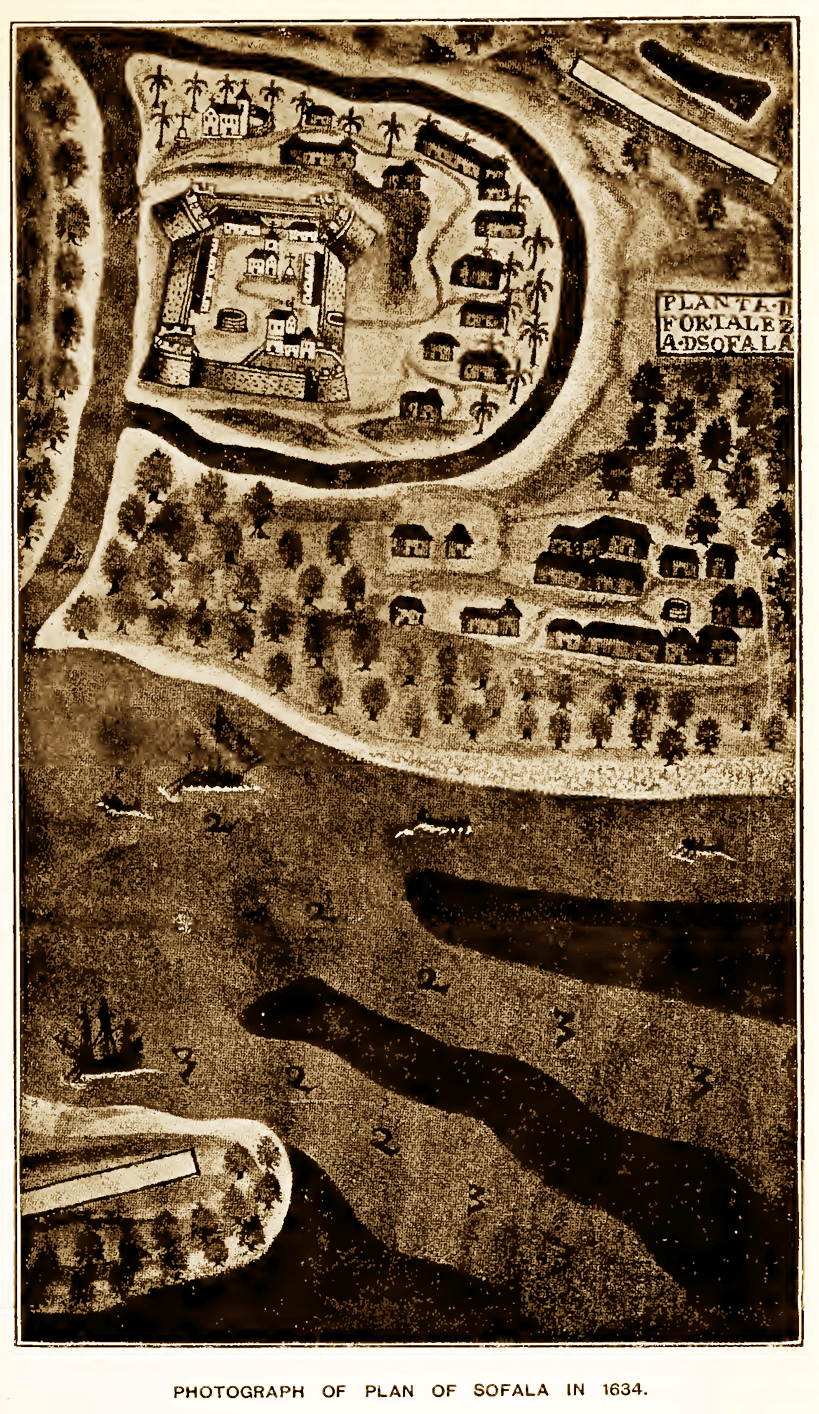
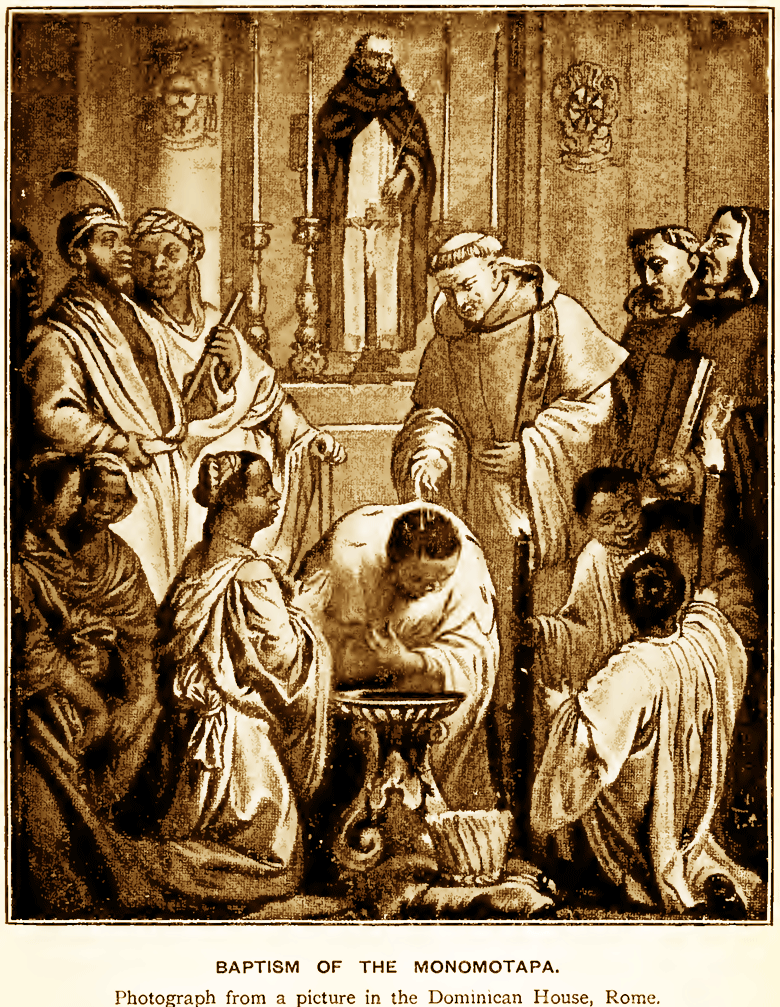
Sofala is described in it as having a square fort of stone nine metres in height, with circular bastions at the corners, and nine small pieces of artillery on the walls. It was without other garrison than the captain and his servants, and had no stores either of provisions or materials of war. In the village adjoining it three married and two single Portuguese resided, who with their slaves and a few mixed breeds were its only defenders in case of war. The fort and village were on an island at high tide, formed by the river and a broad trench, as shown in the plan accompanying the description ; but at low tide the trench was dry. A Dominican friar resided in the village, but there were very few Christian Bantu. The only commerce carried on was in ivory and ambergris. The kiteve, in whose dominions the fort was situated, had ten or twelve thousand warriors at his command, but was in general friendly to the Portuguese, and on payment of the usual quantity of merchandise allowed them to trade in freedom and safety. Sena was a much more important place, though the old fort was out of repair and almost destroyed. There were thirty married Portuguese and mixed breeds in the village, who owned a large number of slaves, and there were no fewer than four churches, with religious of the Dominican order and the Company of Jesus. The principal building was the factory, which was under a tiled roof. It was a great warehouse, in which the goods of the captain of Mozambique were stored, and where merchandise was sold wholesale to the traders who traversed the country. There were two dwelling houses under tiles, all the others being thatched. Along the river up and down were great tracts of land, occupied by fully thirty thousand Bantu, that had been assigned to individual Portuguese, who, however, did not derive much benefit from them, as most of the Bantu were disobedient. This system was in accordance with feudal ideas, the persons to whom the districts were assigned having extensive powers wherever the Bantu were submis- sive, but being themselves vassals of the captain of Sena. Among the owners of districts in this way was the Dominican order, whose claim was confirmed by the king in 1638. At Tete there were twenty married Portuguese residents and a few half-breeds, all living within a kind of fort, which consisted of a wall a little over two metres high with six bastions, on which a few small pieces of artillery were mounted. They had many slaves under their control. Adjoining Tete were lands occupied by about eight thousand Bantu, parcelled out among individual Portuguese, like those connected with Sena. Scattered over Manika and the country of the monomotapa were numerous so-called forts, which were really only palisaded enclosures or earthen walls, occupied by traders and their servants. At most of these Dominican friars also resided, who occupied themselves with the conversion of the Bantu. By the king's orders this field was open to them alone, though the Jesuits, who occupied Kilimane and the country to the northward, were permitted to have an estab- lishment at Sena, and often evaded the command and stationed missionaries with the Makalanga. By a royal order the Dominicans were entitled to tithes in the country south of the Zambesi. The Jesuits had a large estate assigned to them on the island of Luabo, between two mouths of the great river, which was regarded as being within their sphere of action. The only soldiers in the whole country were thirty men who accompanied the monomotapa wherever he went, nominally as a body-guard to protect him and add to his dignity, really, it may be believed, to keep watch upon his movements. There were still a good many Mohamedans scattered about, and they were regarded by the Portuguese as in general irreconcilable enemies. Those on the island of Luabo were said to be behaving well, but those in the monomotapa's territories had aided Kapranzine, and after his defeat were reduced to abject circumstances. It had not been found possible to expel them. The only courts of law open to Portuguese subjects in the country south of the Zambesi at this time were those of the captains of Sofala, Sena, and Tete. These officials were appointed by the captain of Mozambique, who selected them from the circle of his friends more to promote his interests in trade and to ward off hostilities with the Bantu whenever they could do so, than with an eye to their qualifications as magistrates. Under these circumstances it cannot be supposed that justice was at all times administered. There was, however, a right of appeal from the sentences of the captains to the judge at Mozambique, which may have prevented gross abuses. This is the picture of Portuguese South Africa given by the most competent writer of his day, and certainly it differs greatly from that presented by the royal despatches. 1630]Wreck of the Sao Gonçalo Some wrecks which took place on the South African coast during these years furnish matter of sufficient interest to be preserved in history. That of the Sao Joao Baptista in 1622, and those of the Nossa Senhora da Atalaya and the Sacramento in 1647, will be referred to by me at sufficient length in a chapter upon the Xosa tribe in another volume ; but two others remain, the narratives of which may here be given. On the fourth of March 1630 the Sao Gonçalo, commanded by Captain Fernao Lobo de Menezes, sailed from Goa for Lisbon. On the passage she became leaky, and in the middle of June put into Bahia Fermosa — Plettenberg's Bay as now termed — in a sinking condition, to be repaired. For this purpose some of her cargo was landed, and more would have been if the officers had not shown themselves quarrel- some and incompetent for their duties. Some of the crew took up their residence on shore, but the greater number remained on board. Fifty days after her arrival in the bay the ship was lying at anchor off the mouth of the Pisang river when she was struck by a storm and driven ashore, one hundred and thirty-three persons perishing in the wreck. The captain, five friars, and about a hundred men were on land at the time, and fortunately they were able to collect a quantity of provisions and a good supply of carpenter's tools when the storm ceased. In anticipation of being obliged to remain there until the change of the monsoon in September or October, they had made a garden, from which they obtained such vegetables as pumpkins, melons, onions, and cucumbers. From the bay they drew supplies of fish, and from the Hottentots, who were very friendly, they bartered a number of horned cattle and sheep for pieces of iron. They were thus enabled to put by much of the rice that had been landed before the wreck and such food in casks as drifted ashore, while they were building two large boats in which to make their escape. The captain was old and feeble, so with his consent they elected Roque Borges to be their commander. There was plenty of good timber in the forest close by, and as much iron as they needed was obtained from fragments of the ship. For tar they used benzoin, recovered from the cargo, and mixed with the oil of seals, which they killed in great numbers on an islet off the mouth of the river. Having plenty of food they lived in comparative comfort, and they were not forgetful of the worship of God, for they built a chapel in which religious services were frequently held. Eight months passed away before the boats were completed and ready for sea. When all was prepared for sailing the friars erected a wooden cross on the site of their residence, and a rude inscription was engraved on a block of sandstone, recording the loss of the ship and the building of the pinnaces. Part of this stone was removed some years ago from the summit of a hill a little to the eastward of the mouth of the Pisang river, and is now in the South African Museum in Capetown. Some of the people wished to proceed to Angola, others thought it would be better to return to Mozambique, so the two boats steered in opposite directions. The one reached Mozambique safely, the other after a few days fell in with the homeward-bound ship Santo Ignacio Loyola, and her people were received on board. But these were less fortunate than the others, for they perished when near their homes by the loss of the ship that had apparently saved them. The wreck of the Nossa Senhora de Belem was in many respects similar to that of the Sao Gonçalo. Where every one, as in Goa at that time, regarded bribery and corruption as the natural means of acquiring wealth, even a ship could not be sent to sea in a condition fit for a long passage. She would be repaired with rotten timber, her caulking would be defective, her rigging and stores would be of an inferior description. Thus the Nossa Senhora de Belem, commanded by Captain Jose de Cabreyra, sailed from Goa for Lisbon on the 24th of February 1635 shorthanded and quite unfit for navigation in stormy seas. As usual, a large proportion of those on board were negro slaves. The ship soon became so leaky that it was with the greatest difficulty she could be kept afloat, and when she reached the South African coast the only hope of saving the lives of those on board was in running her ashore. Somewhere north of the mouth of the Umzimvubu river — the exact spot cannot be made out — she lay almost water-logged close to the coast, when a boat was got out, and the captain landed with a few men to look for a place where she could be beached with the least danger. Night came on, and some Kaffirs appeared, who attacked the little party, but they were easily driven away. In the morning those on board, fearing every moment that the ship would go down with them, waited no longer for the captain's signal, but ran her ashore, and fortunately for them she held together, so that no lives were lost. Two hundred and seventy-two individuals, among whom were five friars, were now safe on land. For seventeen days they were engaged in getting provisions, tools, and other articles out of the wreck ; then by an accident, either from the party that had been on board during the day- having left a candle burning or a fire in the stove, she caught alight and the whole upper part was consumed. This, however, turned out to be an advantage rather than a misfortune, as an abundance of nails and other iron was now easily obtained from the charred timber. There was much difference of opinion as to the best course to be pursued, but at length they agreed to build a couple of small vessels and try to get to Angola. There was a river close by that offered a favourable site for a shipyard, and plenty of timber was to be had in the neighbourhood, so on the 20th of July they set about the task. Soon afterwards they were cheered by the appearance of a cabra, that is the son of a mulatto by a black woman, who called himself a Portuguese, and in broken language told them that his name was Antonio and that he had been wrecked in the Santo Alberto and left there by Nuno Velho Pereira's party that went to the north more than forty years before, when he was a boy. He was now wealthy and a man of influence. He was accompanied by a chief with a band of attendants, with whom an agreement of friendship was made. Through Antonio's influence and assistance no fewer than two hundred and nineteen head of cattle were obtained in barter for pieces of iron, which not only furnished plenty of fresh meat for the time being, but abundance of biltong, or strips of dried flesh, for provisioning the boats. After a time the shipwrecked men suspected Antonio of hostility, and there was some trouble with the Bantu; but their wants had then been supplied, and they were too strong to be attacked. Six months were occupied in building and fitting out the vessels, which were decked and of such beam that they could carry the whole of the people. They were provisioned with eighty small bags of rice and a quantity of biltong. On the 28th of January 1636 they sailed from the river, but found the weather rough on the coast, and during the second night after leaving one of them disappeared and was 473 not seen again. The other, in which was Captain De Cabreyra, put into Algoa Bay on the passage, and forty- eight days after leaving the river reached Bengo Bay, close to the town of Sao Paulo de Loanda, with her provisions exhausted and without a drop of fresh water left. There, just in time, those on board were rescued from death by starvation and thirst, and soon afterwards they dispersed to different parts of the world. 1640] The Revolution in Portugal. In 1640 the revolution in Portugal took place which elevated the eighth duke of Braganca to the throne as King Joao IV. Margarida, duchess of Mantua, was then governing Portugal for Philippe III — the 4th of Spain, — and her court was almost entirely composed of Spanish grandees, who treated the Portuguese nobles with such disdain as to rouse their passion. The people were discontented, and attributed the poverty and distress they were suffering to the Castilian yoke which lay heavy upon them. Though under the same head for sixty years, they had never fraternised with the Spaniards, and the loss of their most valuable eastern possessions, which had been the result of the political union of the two countries, was ever in their minds. The time was opportune for a revolution. The Catalans were in insurrection, and France could be depended upon to favour anything that would weaken the power of Spain. A number of Portuguese noblemen then conspired to eject the hated dynasty. On the 1st of December 1640 they seized the palace and forts in Lisbon and the Spanish armed ships in the Tagus, and made the duchess of Mantua a prisoner. A few of the Castilian officials were killed in the first moments of the rising, but most of them were merely placed in safe confinement. The duke of Braganca, though timid and half reluctant, had then no option but to ascend the throne, for he was the legitimate heir of the ancient kings, and his life would not have been worth a week's purchase if Philippe should recover his authority. On the 15th of December he was crowned in the cathedral of Lisbon, and the cortes, which met as soon as possible, unanimously took an oath of allegiance to him on the 19th of January 1641. The whole country declared in his favour, the Spanish garrisons were expelled, and Portugal again took her place among the nations of Europe as an independent power. War with Spain followed as a matter of course, but Joao IV found powerful allies among the northern rulers, his people sprang to arms, and he was able to preserve the throne on which his descendants sit to this day. In India tidings of the successful revolution were received with the greatest joy. The silly orders of the Castilian monarchs sent through the regency at Lisbon, and the affectation of boundless wealth and numberless men being at the disposal of the viceroy, must have disgusted the officials everywhere. From the new monarch they had reason to expect instructions dictated by common sense, and indeed in his first letters to the viceroy he spoke plainly of his empty treasury and of the necessity there would be of observing the strictest economy in every part of his dominions. Then he was their own countryman, and blood cements loyalty. Among the first of foreign powers to recognise him was the Republic of the United Netherlands, and on the 12th of June 1641 a truce for ten years was concluded between the two governments, in which, among other clauses, was one defining the Portuguese possessions in South-Eastern Africa that were thereafter to be respected by the Dutch. They were Mozambique, Kilimane, the rivers of Kuama, Sena, Sofala, Cape Correntes, and the adjacent rivers, by which were meant Imhambane and the bay of Lourenco Marques. This truce was broken a few years later through events that took place in Brazil, but while it was observed it was of much importance to the new king. It gave him sympathy and some practical assistance from the Dutch people in his struggle with Spain, and it freed the eastern possessions that were left to him from fear of attack, of which they had before been apprehensive. The king indeed was led even to hope that some of the ancient conquests, particularly Malacca, might be restored to Portugal. Still he was not without some uneasiness when he reflected upon the defenceless condition of his dominions on the borders Of the Indian sea, the activity of the Dutch in that part of the world, and his inability to afford any assistance, owing to his empty treasury. He therefore instructed the viceroy to keep a close watch upon the movements of the Dutch, but to act with the greatest caution, and to avoid everything that might irritate or offend any one. The measures adopted by the government of King Joao IV with regard to South-Eastern Africa were not productive of good, however, much as the more honest and sensible tone of his despatches is to be admired. In December 1643 commerce between Portugal and India was declared free and open to all his subjects, with the single exception of the trade in cinnamon, which was reserved as a royal monopoly. This, to Englishmen of the present day, will appear a liberal measure. But there are circumstances when the admission of all persons under the same government to equal commercial rights may prove utterly ruinous to the class that ought to be encouraged most, and it would have been so in this instance in the country south of the Zambesi if the existing contracts with the prospective captains of Mozam- bique had not prevented its coming into operation for several years, and if in the mean time other measures had not been adopted. This will be dealt with more fully in another chapter. In 1644 the slave trade between Mozambique and Brazil was opened by individual adventurers with the king's permission and encouragement. In these days such traffic is justly regarded with the greatest horror, but during the seventeenth and eighteenth centuries not a voice appears to have been raised against it. It certainly was not looked upon as cruel or immoral to remove negroes from an environment of barbarism to a condition of subjection to Christian masters. The system brought upon the lands to which the slaves were taken a terrible and perpetual punishment, which ought to have been foreseen, but was not, or at least was disregarded in the prospect of immediate gain. The proprietors of the prazos, or great estates, along the Zambesi had now a new source of wealth opened to them. Hitherto they had re- garded the captives obtained in war and reduced to slavery as personal followers, and employed them as traders, soldiers, attendants, and so forth, he who had the greatest number being esteemed as the most wealthy and powerful. The blacks readily fell in with this system, which appeared to them natural and proper ; and in general they were found faithful. It gave them what they needed : some one to think for them, some one to direct and look after them. But after 1644 all this was changed. The Batonga and Makalanga who were made captives were considered as worth so many maticals of gold a head, and any that the owners did not care to keep were sent to Mozambique for sale, to serve in ships like the less intelligent Makua or to be con- veyed to Brazil to work on plantations, in either case to be severed for life from early associations and companions. As time went on the abominable traffic grew larger and larger, until it became far the most important in money value of all the commerce of the Zambesi basin. There could be no extension of agriculture, no mining, no progress of any kind where it was so extensively carried on. In 1644 there was a war between the kiteve and a chief named Sakandemo, in which the Portuguese took part on the side of the former. The result was the defeat of Sakandemo > the baptism of the kiteve with the name Sebastiao, and his promise to regard himself thereafter as a vassal of Portugal. But conversions of this kind, however gratifying to the vanity of the Europeans, and especially of the clergy, were of no real value, and such promises of vassalage by men possessing any real power were not carried into practice. The sparseness of the European population made the possession of the country extremely insecure, for no troops could be provided to guard it. But how or where could settlers be obtained ? Not in Portugal, for there were much more attractive places than South-Eastern Africa before the eyes o£ the peasantry there. Not voluntarily in India, as had been proved by the viceroy's invitations and tempting offers to migrate having had no effect. And so they were sent involuntarily. After the middle of the seventeenth century what colonisation was effected on the banks of the Zambesi was largely the result of criminals being sentenced by the supreme court at Goa to become residents there. If morality before this had been low, hereafter it sank to a point seldom reached elsewhere by Europeans. At this time our countrymen began to frequent the coast, as the Dutch, notwithstanding repeated orders to prevent them from trading with the inhabitants, had previously done, and English adventurers soon became a source of much uneasiness to the government at Lisbon. The first difficulty connected with them occurred in 1650, when an English trading vessel arrived at Mozambique. Alvaro de Sousa was then captain, and finding that he could do a profitable business with the strangers, he purchased a quantity of goods from them, hoping that the transaction would never be discovered. When the head of the local government acted in this manner, it may well be believed that the subordinate officials and the residents in the village, who had the right of trading with the Bantu on the mainland, were equally dishonest. The matter came to the knowledge of the king, but the death of Alvaro de Sousa prevented the punishment that would otherwise have been inflicted upon him. Orders were again issued, strictly prohibiting commercial intercourse with strangers, who were to be permitted to take in fresh water and to purchase necessary refreshments, but nothing more. 1652] Death of Manuza On the 25th of May 1652 the monomotapa Manuza — or Philippe — died. He had not renounced Christianity and had always kept on the best terms with the Portuguese, acknowledging himself a vassal of the king, protecting traders, and making numerous grants of prazos to individuals. He could not do otherwise while Kapranzine lived, nor while Kapranzine's son of highest rank, the heir to the chieftainship in the direct line, was practically a prisoner in Goa. This young man had entered the Dominican order, and applied himself most assiduously to study, so that, according to the chronicler, he was by his example the most powerful preacher in the country. In 1670 the general of the order sent him the diploma of Master in Theology, equivalent to Doctor of Divinity, and this man, born a barbarian, heir to the most important chieftainship in Southern Africa, died as vicar of the convent of Santa Barbara in Goa. Fiction surely has no- stranger story than his. Manuza's successor adhered to the old Bantu faith, and in consequence the Dominicans were in much distress, as their work seemed likely to be thrown back seriously. Great was the pleasure therefore which they felt when the new chief, under the teaching of the friar Aleixo do Rosario, announced his conversion, and requested to be baptized. His example was followed by a multitude of the sub-chiefs and others. On the 4th of August 1652 these were all received into the church, the monomotapa taking the name Domingos and his great wife Luiza. The intelligence of this event created a joyful sensation in Europe. At Rome the master- general of the order caused special services to be held, and had an account of the baptism engraved in the Latin language on a bronze plate. At the Dominican convent in Lisbon there was a grand thanksgiving service, which was attended by King Joao IV and all his court, for the event was regarded as one of the greatest triumphs of Christianity, as well as a consolidation of Portuguese rule in South Africa. Such an opinion, however, was altogether erroneous, for in this same year, 1652, the Dutch East India Company formed a settlement in Table Valley, which was destined to have a vastly greater effect upon the southern portion of the continent than the Portuguese occupation of the eastern coast, that had now lasted nearly a century and a half.
CHAPTER XX. WEAKNESS OF PORTUGUESE RULE IN SOUTH AFRICA.
|
 |
 |
 |