READING HALL "DOORS OF WISDOM" |
 |
 |
INTRODUCTIONTO THE CREATION OF THE UNIVERSE ACCORDING GENESISPART SIX.CREATION OF THE SOLAR SYSTEM
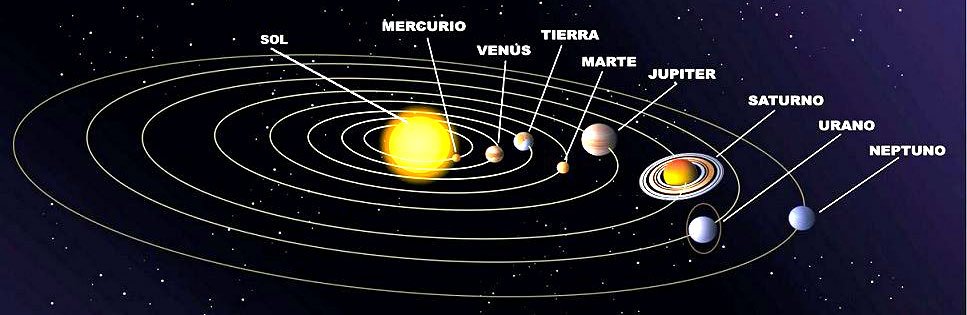
CHAPTER 21 APPLIED FINISTIC SYSTEMOLOGY (DYNAMIC STRUCTURE OF THE SOLAR SYSTEM) 173. The answer to the enigma posed in the previous section—namely, what kind of automatic brake maintains the cruising speed of the Solar System equal to itself, contrary to the law of gravity that dictates the necessity of constant acceleration due to the decreasing distances between the Sun and any point it approaches?—is unequivocal. Now, and I confess my failing, duty demands that we further specify the nature of the problem. I mean, we are, and have been, accustomed to working with a snapshot of the Solar System. Here it is:
174. By inertia and prior virtual simulation implanted during the years of our intellectual formation, we tend to be omniscient, and the application of Kepler's laws to the imaginary snapshot is enough for us to feel like gods. This implantation dates back centuries, and The image is so subtly ingrained in our very being that intellectual professionals need only impose order with the baton of their state regimes to resolve the issue. The fact is that today, this simplistic image of Keplerian motion is characteristic of retarded minds and intellects devoid of any independent activity and lacking any capacity for critical judgment. The truth is, the result looks good, even beautiful, and achieves its objective: to make even the most idiotic person feel greater than a Saint Thomas and a Saint Augustine combined. When it comes to its correspondence with Reality, this image of a Solar System frozen in time is the complete opposite of the Physics of a Solar System that moves among stars just a few light-years away and with which it forms—by all accounts, a cacophony?—an Open Star Cluster. Let's do a simple mental exercise: place the classic plane representing the Solar System vertically and see the Planets flying from back to front, with a Sun at the center moving at its own speed. What do we get? It seems obvious that the image we see in our minds is that of a moving magnetic field, created by the Sun, around which the planets move forward, tracing a wave in space. In the image below, place the Sun in the center and imagine that the brown ribbon is the movement of a planet around it. Multiply this ribbon by nine at different distances, all moving in pursuit of the same star as it moves through space at its own velocity. Once this is done, make the Sun's trajectory that of a star with relative motion, that is, within a closed spacetime; the result will be a nutation. The next problem will be to determine which are the members of the Solar Star Cluster.
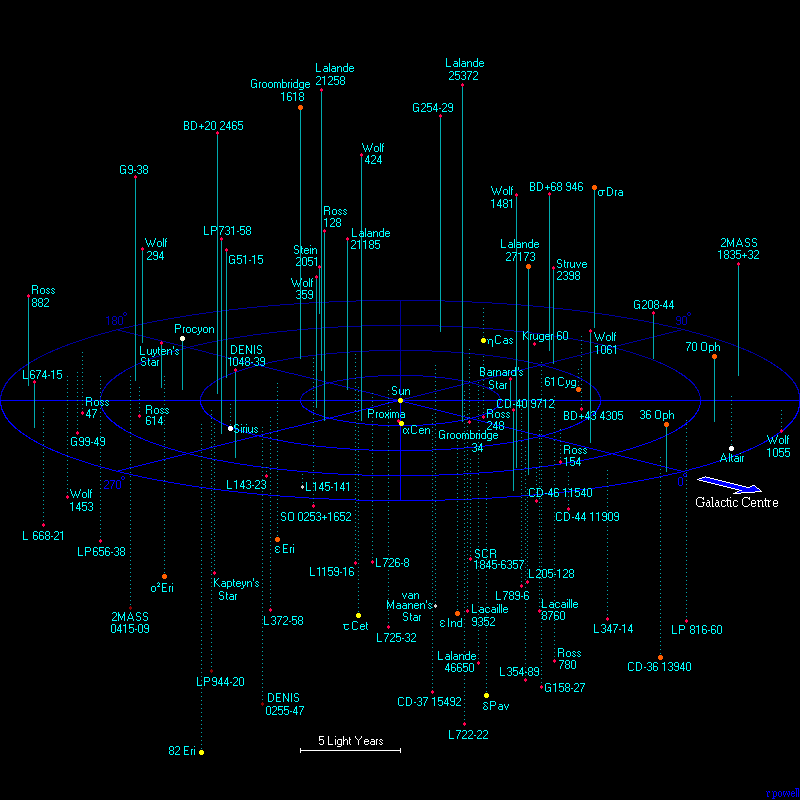
175. If we take as a measure the parameters of the open star clusters in our skies, and combine those of binary and multiple star systems, where the distances between the stars of an Individualized Star System often exceed the distance between the Sun and Alpha Centauri, for example, I wonder, where does this fit in? That photograph for children newly initiated into Astrophysics, the one that came out of Kepler's workshop in the olden days? They say the law operates at infinite distances, yet they deny that the same law acts between bodies located a mere four or five light-years away? Someone, besides common sense, lost their reason during the 19th century, and no one in the 20th century, when the Academy embarked on the adventure of the Search for the Origin of the Cosmos, already settled in the Time Machine that was to carry the wise to the Core of Origin and from there leap to the End by means of a fold in Space... no one thought to press the button and activate the photograph of the Solar System frozen in time that Kepler launched into the future. Not even for a bit of fun. The dogmatism of the disciples of the Einsteinian revolution proved to be so primitive and strong that even with the most current dynamic calculations on the table, no astronomer dared to put their finger to the button and see the Solar System as it was. which exists in Space and Time, embedded in a Local Star Cluster, and whose planetary members possess a solid structure. It is, therefore, laughably depressing to open an Astronomy Manual, written by Professors, such as the one from the Complutense University of Madrid (to avoid getting lost in more subtle terminology), and read that Pluto is a gaseous body. Because one is well-mannered, one can hold back the nausea. Let us continue, then. 176. I stated above that the answer to why the speed of the Solar System defies the rule of gravity, which governs the entire universe, must be unequivocal, simple, and logical. I now recognize that verbal expressions, unlike mathematics, possess an ambiguity so profound that they can swallow the purity of any mountain of numbers into their abyss. And I would like to explain this enigma. Ultimately, words are vehicles capable of carrying different travelers within them, and depending on the traveler, a word can cease to mean one thing and acquire a new meaning. Politicians are masters of this art. But not only them; let's not be cruel to these creatures. Numbers, for example, are perfect entities; their meaning is untransferable, divine in its incorruptibility, and hence the pagan, savage adoration that mathematicians feel for them. A four is a four, and whether applied to bananas or mice, the essence and substance of the four, as an abstract, pure, immaculate entity, remains despite changes. I, being a fool, and being so, serve as an example, since I can be just as much a cretin as a flower, hence the ambiguity of the word, a confusion to which the number lends itself under no excuse, and because I defend the need to press the button of the Solar Systemic Movement in order to overcome Keplerian traumas and the complexes inherited from past centuries, I reserve for myself the laughter that I feel when I see on the Net the staunch defense of this ancient system which, if in its day it was born to revolutionize, is currently the most reactionary system I know. I don't know why astronomers don't do their job and don't process the mountain of data with which, had Kepler and Newton worked, the finished picture of the inherited system would have already been added to the long list of errors—necessary as a step forward, but enemies of Civilization for refusing to be relegated to history. 177. But the fact that an answer can be unequivocal doesn't mean it shouldn't be complex. Everything will depend on the model being used. If the reasoning clashes with an intelligence anchored in the archetypal image that identifies planets as balls of gas, ultimately we will arrive at the bridge of sighs, to write a melancholic "Poor thing!" upon the waters. Having overcome this problem, and assuming that the database at our disposal makes it impossible to maintain an answer derived from a series of data points insignificant at the foot of the mountain of knowledge from whose summit we once again contemplate the Universe, the Cosmos, and the Solar System, the decision is ours. The processing of this cluster of parameters has been entrusted to us. Their final equality, based on a new set of data, must logically present us with a Local Stellar Architecture. With respect to this architecture—without rejecting the Keplerian photo finish—this Applied Finistic Systemology seeks to be nothing more than the opening act, and never the final point, to the central question of this Section: why is the Sun's speed stable and deviates from the law of universal gravitation, according to which, as the Sun approaches an astrophysical system, its speed should double depending on the distance? 178. It is clear that the mere fact of its complexity does not make an answer any less simple. It must be placed in its true context. The nature of the problem it embodies must be clarified. The law it incites must be defined. Space must be created, and the nature of the question to which we seek an answer must be drawn on the screen of our intelligence. There comes a point when experts must intervene, for they are the ones who possess the data bank processing it, which can demonstrate or refute, if applicable, the integration of the Sun within a star cluster, more or less open and more or less populated depending on the gravitational architecture to which that data gives rise. Let us take a new local stellar expansion to 20 light-years:
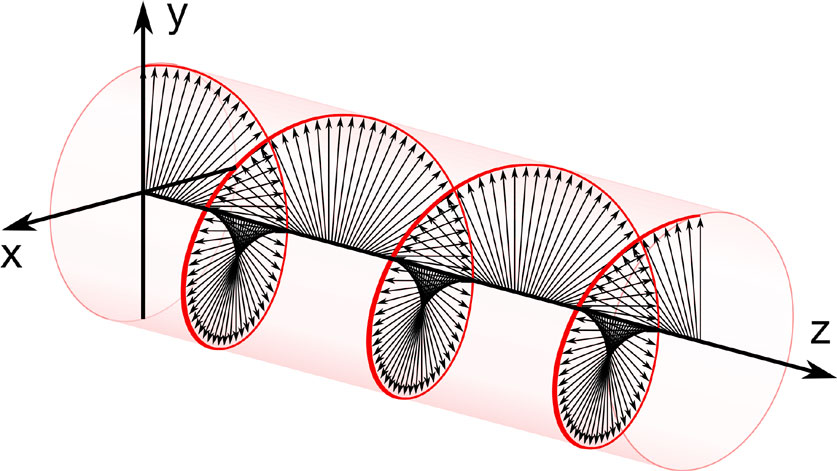
179. How many open star clusters could serve as an astrophysical model? We are obviously talking about a true revolution in our conceptual understanding of what constitutes a star cluster. We will have to discard old concepts and work from binary systems to the opening of regional gravitational fields in universal space, within whose perimeters stars behave like atoms within an astrophysical molecule. This would explain the optical constancy of star formations in the firmament, the constancy of distances and velocities of stellar systems within the Milky Way, and would present us with a Universe that behaves like a crystalline body, fueled by gravitational currents, according to which the consumption of total energy remains within a range of maxima and minima over time. Hence the fluctuations in stellar luminosity. This implies God, of course, but in this Cosmological System, God is taken for granted, so let us now address the local answer to the problem of the constancy of the Sun's velocity. 180. At present, I must correct myself, and having highlighted the truly important point—the existence of the Sun as a Member of a Sidereal System—my own thinking leads me to define the transformation of planetary mass into a Solar Orbit Correction Mechanism, by whose action the Centrifugal Force to which the Sun is subject in response to the Motion of its System within a Cluster Gravitational Field is canceled and becomes subject to a specific constant. If I previously stated that “We need only transform the total mass of the planetary family into drag mass, and we already have the stabilizing brake for the Sun's cruising speed,” I now believe that this transformation concentrates its weight in the Sun's Orbit Correction Equation, by which, as I have said, the centrifugal force to which the Sun is subject is overcome through the transformation of planetary mass into Remote Steering Control. (If the objection arises, imagine running while pulling only your bodies, and then repeat the same operation carrying a sandbag on your back. This is a starting point. But before we shoulder not the globe, like that titan, but the nine planets with their satellites and the solar ring belts, before we pick up the lever to move the universe, we will have to abandon the burden of the decadent view of the planets as immense balls of gas floating among the electromagnetic threads of the Sun's field.) 181. I want to emphasize this point because I believe it is important. The academic assertion that planets are balls of compressed gas under gravitational pressure is one of those primitive pseudoscientific arguments, typical of 20th-century fundamentalism, that cannot stand on their own merits in any way, yet persist in the 21st century as a symbol of universities' submission to the genius of scientific atheism. How long will idiocy and genius go hand in hand on opposite sides of the same coin? It's not easy to say. Until very recently, for example, Mars was a ball of gas, like Venus, Mercury, Jupiter, Saturn, and the other members of our Solar System. And this continues to be stated in textbooks written by the most prestigious minds on the planet for mass consumption. Photos and expeditions to Mars and its neighbors serve as proof of this—the absurd gaseous view of the planets. However, the evidence is insufficient to erase this shameful fabrication from astronomy textbooks and natural science books. It is therefore laughable, bordering on the absurd, to see the eminent geniuses of astronomical observatories around the world continuing to preach the gospel of the gaseous nature of the planets. They must have some hidden reason for confessing with their lips what their ears consider heresy. Now, if there is some eminent super-sage at any of the world's universities who can prove that Mars is a ball of gas, don't remain silent and exorcise us, for by fulfilling the will of such a mega-god, we will all be sent to the Tartarus of fools. It is truly embarrassing—I say—to see in astronomy textbooks words that could only be excused in the mouth of an idiot; embarrassing because those who write them are all eminent figures, holders of professorships and the like. Does the 21st century deserve the typical mind of a fool as its teacher and guide to understanding the universe? The question remains: under what kind of philosophy will we grant a Cosmology of suicide the floor, knowing that its effects on nations, this time with infinitely more deadly means of destruction at its disposal, will be the same? Let us remember that Satan did not kill with a sword, but with words, because, although there are still those who do not believe it, the ultimate weapon, for good and for evil, is the word. How then can we believe these days that Pluto is a ball of gas? At this point, one must be a true fool to teach such nonsense, and an idiot to believe it. The writer, and the reader, outside that typical 20th-century vicious circle, are now interested in discovering how the sum of the total planetary mass comes into play when it comes to the corrective stabilization of the Sun's cruising speed. Let us return, then, to the problem at hand, for on another occasion, circumstances themselves will lead us back to the belly of this black hole in whose gut the brains of the world's youth are washed, where, contrary to nature, it is written that planets are balls of gas. And I am Little Red Riding Hood, of course. 182. Let us then pick up the thread. Sailing at cruising speed X, we have among the constellations of the Heavens a star called the Sun. The friction of this ship against the flight surface is negligible to slow its speed; and what is more natural, the thrust of the centrifugal force to which its orbit is subject propels this ship outward from the gravitational field to which it belongs. Our problem is understanding why the Sun's approach speed relative to the star it's moving towards doesn't increase over time. Regardless of whether the Sun travels in a straight line or along a curved path, as it navigates through interstellar space, the distance between it and the apparent point of approach decreases. That's obvious. And as the distance between the Sun and the apparent point of approach decreases, the gravitational pull between the Sun and that point increases. The law of gravity prevails. As the attraction between the Sun and the reference star system increases, the approach speed also increases. Consequently, the cruising speed of our solar system increases. And it keeps adding up. The shorter the distance between two celestial bodies, the higher the speed of the smaller one becomes. We may or may not be talking about the Sun. Whether the Sun is the larger or smaller of the pair, the fact remains that there is a change in its cruising speed. But since we're talking about the Sun... let's discuss it. 183. I believe the distance from the Sun to the nearest star system is a mere few light-years. Proxima Centauri is about four light-years from the Sun. Even closer stars have been discovered. At the Sun's speed, about 600 kilometers per second, a collision between the Sun and the Proxima Centauri system, counting from this moment, would take place in approximately 500 years. We now ask ourselves point-blank: How many thousands of years has the Sun been navigating among the constellations of the heavens? And from these millions of years during which life on Earth has continued its course without experiencing a lethal alteration, can we not deduce the stability of the Sun's cruising speed? And are we not within our rights to believe that the Sun's speed is a constant? And being a constant, doesn't this constant compel us to correct the phenomenology of gravity, not as a law, but in terms of its nature? I'll add to this excerpt by specifying that my questions aim to broaden the field, never to close off possibilities. To the best of my knowledge, I do my best to condense the information in order to view the process from a dynamic perspective. I don't subscribe to the Keplerian "photo finish" mentality, and if I relate the movement of the planets around the Sun to anything, it's to an electric current flowing through a metal bar, like a solenoid. The very angularity of the orbits projected into three-dimensional space reveals the necessity of a current-wave flight where the Sun occupies the position of the metal bar. Something like this:
184. Working from this image, the three-dimensional aspect is simplified, and the nutational irregularities of some external orbits can be deduced. In another section, dedicated exclusively to the Solar System, I will return to this topic, attempting to further refine the image by importing physical data. My intention with this solenoidal image is simply to displace the image frozen in time that has circulated since the days of Kepler, Galileo, and Newton, and which has become a wall in our times, a cheap idol before which everyone believes themselves to be a genius, and, kneeling, goes home peacefully because they already know everything. 185. The Academy, always so brilliant, knows how to find at every moment the explanation that best suits it to maintain its glory intact in the face of future criticism. And it seems that the Sun travels along an atypical trajectory, such that it avoids gravitational contact with the other constellations. Feigning ignorance, in the style of that Socrates who only knew that he knew nothing, yet knowing everything, the Academy forbids universities from removing from their Astronomy textbooks the falsehoods upon which its idea of the Solar System and its place in the Universe is based. Because, of course, if the Sun doesn't follow a natural trajectory for a body subject to the law of universal gravity, what kind of trajectory does it trace among the other star systems in its neighborhood? The simple calculation I made above between Proxima Centauri can be extrapolated to the last five hundred million years, and given that the Sun has been on the verge of collision five hundred thousand times, the fact that it hasn't collided gives me reason to dismiss the happy idea of a solitary Sun, a member of any cluster. And this should stop you in your tracks, and looking up, feel the vibrations of the stellar engine beneath your feet. Ask yourselves how it's possible that the Sun, in the millions of years it has been traveling at 600 kilometers per second, hasn't collided with any of these other stars in its neighborhood. Doesn't it seem logical to think that it couldn't and can't simply because the Sun belongs to this cluster? I insist on the image:
186. This is indeed an interesting question, which, due to its simple statement, might sound trivial. A serious mistake. Or does the passenger boarding an airplane have no interest whatsoever in the mechanics of the aircraft, knowing as we do that one risks their life in the air? Isn't the entire Sun a vessel eternally in the air, packed with passengers? As for maintaining the solar vessel's autonomous speed, we can deduce it by transforming solar photospheric phenomena into the burning of the fuel necessary to move a body in space. In what ways are large solar flares not similar to the jet of a reactor that propels a spacecraft in the opposite direction of its emission? Aren't both phenomena subject to the same law of action and reaction? Let's suppose for a moment that they are. And since we know the eleven-year cycle that governs the temperature of the solar photosphere, and since this photospheric heating cycle is subject to a stable cycle, can we not deduce from its constancy the controlled propulsion mechanism that governs the Sun's cruising speed, a mechanism in turn subject to the law of transformation of gravitational energy into light energy? The answer is difficult but not impossible. 187. Let's consider the Sun's reaction to the passage of Comet Hale Boop. Do you remember it? Isn't the extraordinary flare seen on the solar surface immediately after the passage of Comet Hale Boop sufficient to open our minds to the connection between temperature, gravitational density, and transformation speed, in this case caused by a wavefront with a solid head? And if the connection between the Hale Boop transit and the extraordinary flare observed is a scientific fact, how can we continue to maintain the same parameters of behavior for the relationship between the Sun and the planets when a minuscule body is enough to accelerate, for a certain period of time, the transformation rate of an entire star? 188. One of the basic pillars of the development of human thought concerns the search for causes arising from observed effects, and conversely, discovering effects based on given causes. Thanks to the intelligence's capacity to use the instruments of logic, the adventure of thought was able to reach unexpected heights. But as time went on, and after many feats, the thinkers who were once revolutionary committed the nefarious crime of eliminating the root cause of the observed effect simply because the discovery did not suit their subjective interests and irrational emotions. Lost in the 20th century in the web of a scientific atheism that erased causes and offered reasons contrary to the logic of reality, it is reasonable to believe that the heirs of those geniuses know how to twist the path between effect and cause and lead the ignorant to the abyss of an outdated irrationality. For, however difficult it may be to believe, Science became atheist to prove to itself that it knew more than God. That it ended its discourse at the foot of the Great War did not make it reflect during the Cold War on the pathology into which its intelligence had slipped its logic. Its pathology was called Atheism. But let us return to the subject of our Solar System. 189. The first one who had to consider all the factors to be taken into account regarding the dynamic stability of the Solar System was the Engineer who conceived its creation within an astrophysical molecular network called the Heavens. The greatest difficulty God faced was the millions of years that the evolution of the tree of species required for its birth and growth. While the processes of creating the biosphere could be accelerated without causing any scientific conflict, the law governing life was and is quite different. In the realm of life, let's put it this way: the laws are more rigorous. The millions of years that the evolution of life on Earth necessarily demanded of God presented him with a complex system of systemic equations. Among these were how to maintain the Sun's cruising speed constant in space and time, and how to provide his system with a flight path that would allow it to glide between the constellations without merging into their systems. These were the two great and principal challenges that his intelligence had to overcome. And it is here, in seeking how he did so, that we find ourselves. 190. The flight autonomy that stars possess due to their nature as transformers of energy into light and heat—a phenomenon very similar to the behavior of an excited particle, which defends itself by radiating a subatomic particle—is an aspect that implies the need to correct the hypothesis of astrophysical motion based solely on the law of universal gravity. This law is not denied; its definition is simply corrected. If until now the law was the only force, from now on we have a mechanism of energy transformation, one of whose effects generates the propulsion autonomy necessary to maintain the system's constant velocity. In this context, the phenomenology of the solar photosphere serves as a frame of reference from which to activate the image of a star as a vessel propelled autonomously by the transformation of its energy into the fuel necessary to maintain its initial momentum. It is another matter entirely if, in its scientific irrationality, the Academy wishes to deny the application of the law of action and reaction to stellar flares and sidereal velocity. The author sees no way in which such a denial can be proven and consequently prefers to continue with his exposition on the relationship between the planets and the Sun's rotation during its trajectory through the constellations that mark its orbit. 191. Let's consider the case. We have the System in which we are going to cultivate the Tree of Life. We know for certain that millions of natural years must pass from the time we sow it until it bears fruit. We also know that the development of Life requires that Nature maintain its Structure under its own conditions. This means that we must avoid interference in the evolutionary process from external cosmological factors. This obliges us to protect the Biospheric System in such a way that, while remaining within a Universe, the existence of this Universe does not create a lethal interference. How to do this? The Sun's own cruising speed, about 600 kilometers per second, and its subjection to the law of Gravity, dictate that as time passes, this speed must increase, which is precisely what we do not want. And consequently, this compels us to equip the Solar System with a safety brake that acts automatically and activates in response to an increase in its speed. That is the goal. Let's see what practical solutions our Creator found. 192. The first practical solution was logical: load the solar spacecraft in such a way that gravitational acceleration would be counteracted by the work of displacement, forcing the spacecraft to transform that exogenous acceleration into the force necessary to perform the work of displacing the braking load. In this practical way, the solar spacecraft would maintain a constant cruising speed, while also overcoming the inertial tendency to increase its speed over time. But let's apply this to the ground. Imagine we have a vehicle fully fueled. The time the vehicle will be on the road will depend, in addition to the speed it develops, on the weight with which we load it. If we load the trunk to the maximum, we reduce the amount of work the tank can perform. We will call this type of brake exogenous. 193. But now let's imagine an even more sophisticated type of exogenous brake. Imagine that as the machine travels a greater distance, the weight of its cargo multiplies. Wouldn't there come a point when the machine would be slowed down, crushed under the weight acquired by this exogenous brake? The question is: Is the Sun endowed with this type of exogenous brake, such that the weight of the planets is multiplied by the potential energy acquired during the elapsed time? And conversely, isn't it by this law of the increase of potential energy and its transformation into weight that the Sun's tendency to behave according to the law of universal gravitation is slowed? 194. If the ideas about the nature of the planets are false, then the numbers must be as well. Which leads me to say that we can't get anywhere while the dictatorship of 20th-century cosmology continues to impose its dogmatic law and its rationalist absolutism on the intelligence of the 21st century. Until very yesterday, Mars—as I said before—was a ball of gas. So if we have to wait for probes to reach Pluto to translate its body into geophysical mass, let's just sit back and wait for death to come; death will come before the probe reaches Pluto. Once the correct calculations are on the table, then we can start working with facts and not with reasons imposed by awards. Moving on, then, from destructive criticism of such geniuses, let's continue traveling aboard the solar spaceship and continue asking questions. 195. The Sun is approaching a star system, and consequently, its acceleration will skyrocket, even against the exogenous braking system. How are we going to overcome this new problem? In the imaginative game we've started, we're in command; we're piloting the ship, and therefore its future depends on us. What we should do now is take the wheel and turn, for example, to the left. Otherwise, we'll crash into the stars of the system toward which the law of gravity is pulling us. Maybe not tomorrow, or the day after. It doesn't matter. Our mission is to find a way to induce the turn that will take us away from the inevitable collision with the system whose gravity has seized control of our ship. The first thing that comes to mind is to look for the wheel. Where is it? Because it's there. Millions of years, and the Sun still on course, are the best proof that God endowed the solar vessel with an external brake—the planets and the interplay of energies that move them—and a steering wheel operated by a remote control program that overcomes the invincible interstellar acceleration, forcing the vessel to turn. My intelligence leads me to look around and ask: What kind of endogenous force is capable of making the Solar System behave like a vessel piloted by an intelligent captain? To make possible this rotation that the Sun has been performing since the dawn of time, and without which mechanism the vessel would have merged into any other star system in the neighborhood: what kind of autonomous mechanics did God endow the Sun with? 196. As yesterday and as always, I raise my arms to my Creator and dedicate to Him the joy that my admiration for the answer He gave to these problems stirs in my intellect. The remote course control program is called Interplanetary Alignment. Once the exogenous brake is created, what's the point of a brake if there's no foot to press it? We'll call this action of the foot on the brake Endogenous Rotational Mechanics. If the exogenous braking action arises as a response of the System as a whole to the universal environment, this action of the foot on the brake arises as a response of the planets to the behavior of the Sun. More or less. But before delving into the effect of planetary alignments on the solar trajectory, I'd like to bring to mind the multiplication of an arm's force underwater and the reduction of a body's weight in the same element. Don't think I'm doing this to mislead you. On the contrary, I'm doing it to open up the natural environment in which the interplay of natural forces moves to our System. 197. Consider that the weight of a body is directly related to gravity. A one-kilogram rock has the same mass on Earth as it does on the Moon. And doesn't that same rock have the same mass in water as it does out of water? Do they have the same weight, though? Of course not. Now we apply this reality to the Sun itself. This is not to claim to match the vision of the genius who sought a lever to move the universe. Imagine, then, that we place the Sun at one end of the lever, we place ourselves at the other end, and it is our turn to move it. The first question we must ask ourselves is what the value of gravity is in the medium in which we have positioned ourselves. Although it may seem like a trick, the lower the gravity, the lower the weight of the body and the greater the effectiveness of the force of the arm against the lever. The deduction is obvious. The weight of the Sun and of any celestial body varies according to the gravitational interaction at any given moment. This is one aspect. Another is that, unlike the Sun, the planets of our System do move in a stable gravitational medium and therefore maintain the equality between the force they develop and the weight they can lift. 198. Planetary Alignment, Total or Partial, Multiple or Simple, acts as an Arm, and its action on the Sun is that of the arm against the lever. The systemic equation states that solar acceleration is slowed by the regulatory program into which God transformed the planetary alignment. The planets transform the weight of the single body into which the Alignment converts them: into force. And, since all force by its nature performs work, the work they perform is to cause the angle of rotation we were discussing and to maintain it constant. This, in effect, is the flywheel we were looking for. 199. As for the physical-mathematical description of this remotely controlled starship in autonomous flight within the constellations of the Heavens, I leave that to someone more expert in numbers, unknowns, and other complex equations. Always highlighting both partial and total planetary alignments within the framework of Applied Astrophysical Systemology, the former acting as a counterweight to speed, and the latter as the displacement of the System's nose toward the hemisphere from which the loading is performed. In short, before sowing the seed of the tree of species beneath the waters of the great ocean, God had to solve many equations. 200. In conclusion: Everything remains to be resolved at the level of final data. Ideas are the prelude to research. And in this context, I wanted to refine my initial idea about the relationship between the planets and the Sun within a shared gravitational field. Just as the solar field itself causes a centrifugal force that ejects bodies and produces the outer asteroid rings, the Sun, being integrated into a multi-stellar field whose center is gravitational—as if it were a point of reference around which cumulative motion occurs—is the cause of a general centrifugal force. The Sun overcomes this force through the overall planetary mass of its system. This ultimately leads us to an astrophysical engineering structure so perfect that abandoning it to chaos is, quite simply, the act of a genius incapable of understanding the complex edifice of equations that this Divine Engineer initially resolved. And because he is unable to accept failure in order to emulate, if not in three dimensions at least on paper, the infinite science of this Creative Intelligence, he opts for the madman's alternative: God does not exist. Let the astronomers and mathematicians of this century take note. 201. Things, then, are what they are, and not what they seem; although sometimes what they seem is what they are. We are talking about an indefinite number of millions of years, time during which the biospheric system demanded its integration into a stable astrophysical structure. So far, the timescales for the described geophysical sequences have not entered the narrative. I left these numbers to the challenges that God overcame one by one. And I believe I have said that once the Creator's Omnipotence is linked to the physical concept of power, natural calculations are consumed by Fire, frozen in Ice, drowned in Water, and evaporated in Air. In how many millions of years did God reduce the sublimation and thawing of the Ice Sheet when integrating the Earth into the Solar System through the northern arc? If the melting of the Ice Mantle had been exposed at the distance corresponding to the third orbit, how many millions of years would the melting have lasted? PART SEVENCREATION OF THE HEAVENS
|
|
|
 |
 |
 |