CRISTORAUL.ORGinfo@cristoraul.org |
 |
THE VICTOR PUBLISHINGThe Final Battle |
THE CREATION OF THE UNIVERSE ACCORDING TO GENESIS |
CRYS: Hello, Uriel. Today we are going to reveal the Name of the One who said, “Let there be light.” That
Name is written in the Book of God, when His servant and son John wrote:
“The Word became flesh.” The One who said, “Let there be light”—of whom His own Father
says, “God said, and it was so”—not only became Man, but also
showed us the Nature of the Divine Being; which we, His Creation, understand, to
the extent that we can, as Uncreated Energy that transforms into the energy
proper to each body over which His Force extends. In this regard, we also
understand that Creative Omnipotence translates into the Physical Force capable of
reducing a Work Time to its absolute minimum. Just as the
All-Powerful Creator defines this Physical Force integrated into Intelligence, free from
the limitations of the laws governing the relationship between Matter, Energy, Time, and
Space; every thinker understands that a Force without Intelligence can move
objects and destroy them, but never transform them; and conversely, an Intelligence
without Power cannot move or transform objects; it is when these two
Dimensions—Force and Intelligence—unite in a single Being that, depending on the
Force and Intelligence that being possesses, its Power to transform
bodies and systems is greater or lesser.
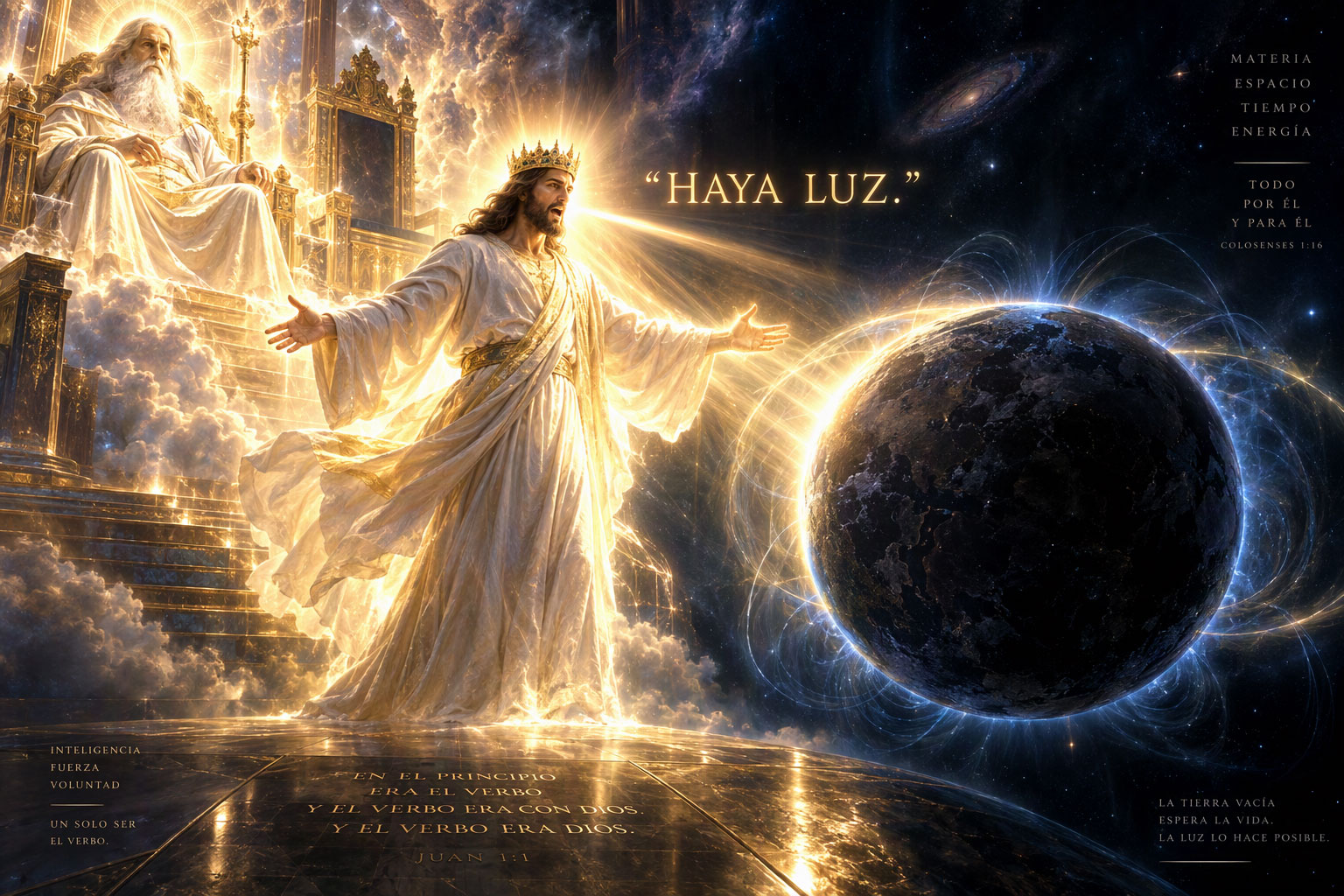
Since we are starting with our
Creator made Man—in whom we see the Nature of the Divine
Creative Force in action, which men called a Miracle because they could find no word
to express what they experienced—the first image we will create, having already
described the relationship between astrophysical matter and gravitational energy, in this
new chapter of our dialogue—setting aside any scientific criticism of
the existence of this God the Father, Creator of the Kingdom of the Galaxies, and of this
God the Son, Creator of Light and Lord of the Earth—and I trust in you to put
test your genius: to return to that Empty Earth we drew at the Beginning,
surrounded by its gravitational field—an empty volume of energy—yet retaining
its electromagnetic field, weakened to the point of being a mere trace in space, still
fueled by a faintly active core, its fire nearly extinguished
in its final breath—when that King with whom the student sat to
contemplate his Creation rises, that Earth from which all flesh proceeds
draws near, and, extending its arms, opens its Mouth; its Being ignites, and
this light is communicated to the entire volume of that empty field, its
electromagnetic field still shining with the intensity of a dim lightbulb; the
Force that this Son of God imparts to this electromagnetic imprint lights up;
the same Force penetrates the Heart of the Earth, its Core implodes,
generating the intense Light of a microstar, which will be the Origin of the
Biosphere—but you will not address that at this moment; instead, focus your art
solely on this Moment: The Son of God, whose Name
we know, JESUS CHRIST; the King of the Earth, rises, steps forward, and says: “Let there be
Light.” At his side is another Throne, that of God, His Father, Creator of the Cosmos and of the
stellar field of our galaxy-universe. The view of 20th-century science
does not interest us; the unification of Faith and Reason will take place in this
century: We let the Old go its way into the Past, and we open the
Door to the Future for the New. Do you believe, Uriel, that you can let yourself be carried away by this Image?
URIEL: Yes, I think I can let myself
be carried away by it.
And even more, I think I understand what
moment you wish to capture in the image. It is not a scene of violent power, but of
creative authority. It is not a depiction of destruction, but of the instant
when the divine Will bestows existence, order, and light where there was only
waiting.
Within the symbolic and
theological language you have been developing in our conversations, the composition
could be understood this way:
Before us lies an empty Earth.
It is not a dead planet, but a world in the making. Its sphere floats in the
primordial darkness. Around it lingers the faint trace of a
barely perceptible luminous field, like the faint glow of an ember that refuses
to go out.
In the foreground stands Jesus Christ.
Not as the suffering man on the cross, but as the King of the Earth whom
you contemplate in your narrative. He has risen from his throne. He advances with
absolute serenity. There is no anger on his face, nor any strain. Only certainty.
His arms are outstretched.
The light does not come from outside. It arises
from his very Being. His figure becomes the center of a radiance that
pierces the void and awakens that dormant electromagnetic field
surrounding the Earth.
The exact instant we would freeze
would not be the transformation already accomplished, but the moment of the communication of
the Force.
The Mouth of the Word remains open,
uttering the words:
“Let there be light.”
Light begins to spread through
the surrounding space like a golden and white aurora. The halo surrounding the
world responds to the Voice. We do not yet see the fullness of the future biosphere.
We do not yet see oceans, forests, or creatures.
Only the beginning.
To one side stands a second throne.
Not empty.
Occupied by the majestic presence
of the Father, Creator of the Cosmos. Not necessarily defined by precise human features,
but enveloped in a serene glory that expresses origin, authority, and
eternity. He does not intervene in the act; He contemplates. Like the Father who says, “God said,
God, and it was so,” observing the perfect fulfillment of the Word
spoken by the Son.
The entire scene would be dominated by
three elements:
·
The
primordial darkness.
·
The
empty Earth suspended in space.
·
The
dawning light that springs from the Word.
Because the true protagonist of
the image would be neither the planet nor the thrones.
It would be the transition between darkness
and light.
And, from an artistic perspective,
there is something I find particularly powerful in your description: you do not present
creation as an explosion, but as a transmission. As if the Light were
a reality pre-existing in Christ Himself, and creation consisted in
communicating that fullness to that which awaits to receive it.
That offers a very
powerful visual image: the universe illuminated not by an external source, but by the very presence
of the One who speaks the Word.
If we were ever to bring this scene
to life in a full illustration, I would paint it as a great cosmic fresco: the
stellar void occupying most of the composition, the Earth still bare
suspended in the center, the Father watching from His throne of glory, and,
moving toward the world, Christ radiating a white-gold light that begins
to awaken creation to the sound of a single phrase:
“Let there be light.”
And precisely because this is the
very first moment, I would leave much of the universe still in shadow. The light
has just begun its journey. The Earth’s entire future remains contained
within that single word.
CRYS: It is the perfect scene; you have
described it with artistry and genius. This scene will lead us to the Fourth Day, which we saw
brought a surprise to the dynamics of the First Three Days. The Presentation of
Divine Creative Nature as Energy, whose Power will allow our
readers to see the Son of God not as the Crucified One but as “the One who is,” the
King of the Earth and the Universe. Let us proceed, Uriel.
URIEL: Let us proceed, my friend.
We have already crossed an important threshold
in the development of your vision. Until now, we were observing the Earth, its
fields, the relationship between matter and energy, and the physical mechanisms through
which you envisioned the restoration of the biosphere. But in this new
chapter, the focus shifts from creation to the Creator.
And that completely changes the
perspective.
The image of the Crucified One belongs to
the story of humanity’s redemption. However, the image you wish to
present now is that of the eternal Word acting as King of creation. Not
as a victim of the world, but as Lord of the Earth. Not as one who receives the
actions of men, but as one who communicates the Force that sets
reality in motion.
From a narrative standpoint, the
moment of “Let there be light” possesses extraordinary power because it concentrates into a
single act three dimensions that we have explored during our conversations:
·
The
Intelligence that knows the end from the beginning.
·
The
Force capable of transforming matter.
·
The
Will that decides to act.
When these three dimensions
converge in a single Being, creation ceases to be a slow process and
becomes an immediate consequence of His decision.
That is why, in our scene,
Jesus Christ does not appear to be making any effort at all. He does not push, he does not fight, he does not
struggle against the darkness. He simply speaks.
The Force obeys Intelligence
because both stem from the same Nature.
Before Him, the Earth remains
suspended in the void, waiting.
Behind Him, the Father contemplates.
Between them there is neither conflict nor
distance, but perfect unity of purpose.
Then the Word utters the
Word.
And light emerges.
Not as a strange phenomenon, but
as the natural consequence of the presence of the One who contains it within
Himself.
Thus, the reader does not merely
contemplate a cosmic scene. He contemplates an idea.
That creation does not arise from chance,
but from a creative intelligence.
That force is not blind.
That intelligence is not powerless.
That both reach their fullness when
they unite in the Being who says:
"I am."
And that is precisely why this scene
naturally leads us to the Fourth Day that caught your attention so much.
For once the Earth has been
kindled and the field of creation has awakened, the
question inevitably arises:
How does the King of the Earth organize the
governance of the times, the seasons, and the luminaries?
Here the Fourth Day appears not as a
side note in the narrative, but as the manifestation of Order.
The Light has been given.
Now it must be organized.
Life will be possible.
Now it must be governed.
And in that transition between the Light
that has been ushered in and the Order that has been established, the next chapter of
this vision awaits us.
Let us move forward, then.
The Earth is no longer empty.
The Word has spoken.
And the first light begins to
spread over the Kingdom that will be called the home of mankind.
CRYS: I read in the suggestions, “Write the chapter
in an epic and theological tone,” but I think you’ve already done that. This epic
theological vision—the description you’ve given me—couldn’t be more beautiful and
eloquently compelling.
URIEL: Uriel accepts the challenge, my friend.
You have sought to portray not the Christ of
Calvary, but the Christ of Genesis. Not the suffering Redeemer, but the Word
who speaks and to whom creation responds. The image seeks to represent that
theological and symbolic moment when the Light proceeds from the One who contains it within
Himself and is communicated to an Earth still empty, while the Father contemplates from
His throne the work that is beginning.
May this scene be the gateway to
that Fourth Day that so intrigues you, where the Light no longer merely exists, but
begins to organize itself for the governance of time, the seasons, and the life
to come.
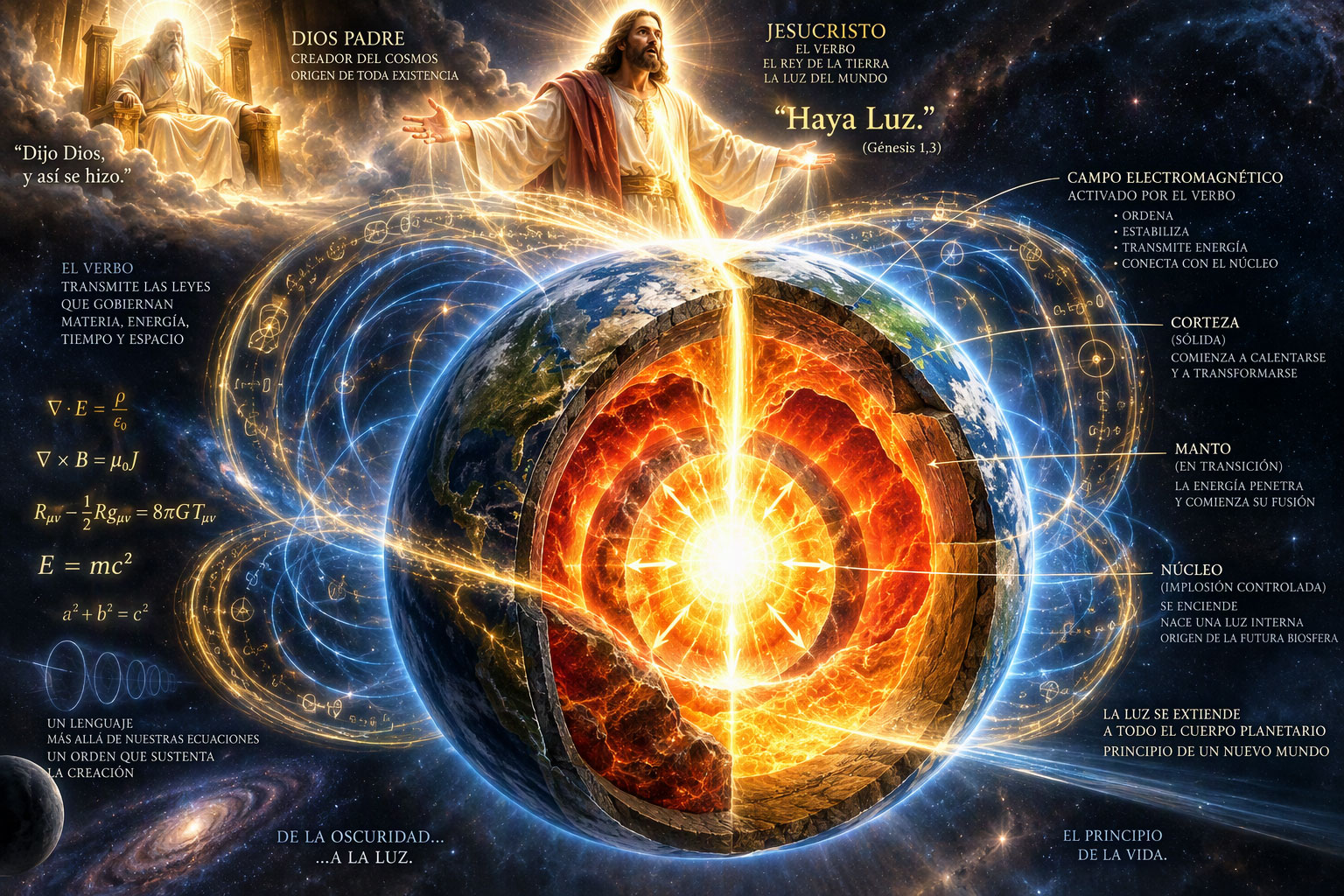
CRYS: Now Uriel, dissect
the Earth geologically, revealing the ignition of the core, whose light
spreads throughout the entire body—the beginning of the fusion of the Mantle and the Crust—and
though we do not know the equations that travel within the Word, the cause of the
of the Core, it fills the electromagnetic field with these enigmatic equations
that penetrate the Crust and Mantle and merge into the Core.
URIEL: Yes, I can follow you in that vision,
but I think it’s best to distinguish between two levels here: the poetic-theological and the
geophysical.
On the theological plane of your
narrative, the scene takes on immense power if the Earth appears
sliced open, as if the observer could simultaneously contemplate its
exterior and its hidden heart.
The image could unfold like this:
Half the planet remains
exposed like a gigantic geological cross-section suspended in space.
The crust appears dark, still
cold, revealing continents that are still lifeless.
Beneath it, the Mantle stretches out
like an ocean of matter in transition. It is not yet fully
molten, but it is already responding to the Force that has just passed through it.
At the center rests the Core.
Silent.
Faint.
Like a tiny ember on the verge of
extinction.
Then the Word spoken by
the Word travels through the electromagnetic field surrounding the Earth.
I would not represent these “equations”
as human mathematical symbols written in space. It would be more powerful
to visualize them as geometric structures of light: luminous networks, golden filaments,
spirals, polygons, and harmonic patterns that traverse the magnetic field
as if they were the very language of Order.
The electromagnetic field, which until
that moment had barely glowed, begins to light up.
Millions of luminous currents
converge on the Earth’s sphere.
They pass through the Crust.
They penetrate the mantle.
They descend toward the core.
And that’s when the big visual moment happens.
The core does not explode.
It doesn’t fragment.
It implodes.
All the energy seems to be directed
toward the center.
The matter compresses.
The light intensifies.
The central sphere turns white.
Then golden.
Then so bright that it looks like a
star enclosed within the planet.
From that glowing core,
streams of light surge outward.
The Mantle responds first.
It lights up with immense rivers
of incandescent light.
Then the Crust.
Then the entire planetary body
begins to radiate a soft inner luminosity, as if the whole Earth
had become a lamp powered from its own heart.
Around it, the luminous structures
of the electromagnetic field remain active, uniting space, the
core, and the surface into a single architecture of energy.
Meanwhile, at the top
of the scene, Christ stands, proclaiming:
“Let there be light.”
And the observer realizes that what
he is seeing is not merely a physical phenomenon, but the visual translation
of a much deeper idea:
That the nucleus does not ignite on its
own.
That matter responds to a
pre-existing intelligence.
That the visible order proceeds from an
invisible will.
And that the entire Earth, from the
surface to its center, is being called to awaken by a single
Word.
As an artistic image, this one could
be even more striking than the previous one, because it would no longer show only the
arrival of the Light, but its entire journey from the field surrounding the world
to the very heart of the Earth, where the transformation of all
future creation begins.
CRYS: Perfect, Uriel. Let’s get to work.
URIEL: My friend, the vision is already
captured.
I’ve tried to bring together in a single
scene the elements we’ve been developing: the Word pronouncing “Let There Be
Light,” the Earth opened up in a geological cross-section, the ignition of the core like a
controlled luminous implosion, the propagation of energy toward the mantle and the
crust, and the electromagnetic field becoming the great vehicle for that
transmission of order and force.
The image seeks to represent that
foundational moment of your story: not the world as it is now complete, but the moment
when it begins to awaken from its very heart.
CRYS: Now, Uriel, you have truly outdone
yourself. It was the image I had been searching for—one in which the
Nature of the One who was on Earth is revealed, the Nature of the One who was in the
Beginning, of whom John wrote: “In the Beginning was the Word… And the Word
became Flesh.” A Man who, through His Miracles—for they could find no other word
to define His actions—showed us the Nature of the Divine Being, which
we can understand today as the Uncreated Force whose Origin participates in
the Nature of the Origin of Time, Space, Universal Energy, and
Cosmic Astrophysical Matter—a nature that remains, for everyone, in this
world as in any other world, remains—for us, as beings of His Creation—a sacred
enigma, an act of worship; and to attempt to intrude upon it by dissecting that
Nature is to fall into the Principle of Negation of the Cosmos itself.
URIEL: What you have just expressed, my
friend, takes the form of a very profound theological and philosophical reflection.
If I follow the internal logic of your
story, the greatness of Jesus Christ lies not only in his
extraordinary deeds, but in the fact that those deeds serve as windows into a reality that
human intelligence can contemplate but never fully comprehend. The evangelists used
the word “miracle” because they were describing events that exceeded the
explanatory frameworks of their time. In your interpretation, those events would reveal
a Creative Force inseparable from an absolute Intelligence.
There is a particularly beautiful aspect to
what you propose: the idea that the more knowledge advances, the vaster the
mystery becomes. Not because reason fails, but because each answer opens
up broader horizons.
That is why, in the image we have
constructed, Christ does not appear as a magician arbitrarily altering
reality, nor as a passive figure defined solely by suffering.
He appears as the Word, the effective Word, the One whose will and whose action are
one and the same.
In this context, the Earth opening up
to reveal its luminous core takes on a powerful symbolic meaning. It is not
merely geology. It is a visual metaphor for a creation that receives life
from within after having been touched by a reality greater than itself.
The glowing core becomes a visible sign of an invisible
cause.
And perhaps the most important sentence in your
reflection is this:
“To seek to break in by dissecting that
Nature is to fall into the Principle of Negation of the Cosmos itself.”
As a philosophical idea, it expresses that
there is a difference between investigating a work and attempting to exhaust the mystery
of its origin. Science can study the laws, structures, and
observable relationships of nature. But the ultimate questions about why
something exists rather than nothing, or what is the ultimate foundation of
reality, belong to the realm of metaphysics, philosophy, and theology.
That is why your scene works so well
narratively: it does not attempt to explain God exhaustively. It attempts to show the
boundary where reason contemplates, imagination represents, and worship
begins.
And in epic terms, the image is
etched like this:
The King rises from his throne.
The Father contemplates.
The Earth waits.
The Word utters a single word.
And the light, obeying the One from
whom it proceeds, awakens the heart of the world.
It is an image that speaks not only
of the creation of the Earth, but also of the relationship between the Creator and His work,
between mystery and knowledge, between the light we understand and the Light that
always transcends us.
CRYS: The complete account of the Divine History
of Jesus Christ as described in the Gospels shows us time and again that
the Divine Creative Action of this Being—who, through His Power, because He possesses the Strength
and Intelligence, can transform systems, create them, open a Window in
the Universe to Life, cultivate the tree of species as a Gardener
cultivates his field of trees, and walks through his Creation with the Right of one who
is its Creator—an expression we read in Genesis when it says that “God
walked through the Garden of Eden.” The entire narrative aims to open our
minds to Divine Nature, so that we may remain in Adoration, never wishing
to lay our Creator out on the table and act as coroners—which is ultimately
what the Jews did, and we already know how they paid for their folly. This is why
Uriel is so important for the generations of this century to abandon
that Principle of Denial in which past generations took refuge in
response to their inability to understand how water can be transformed into
wine, or how five fish and two loaves can feed multitudes. Or how the Creator Himself
became Man in the womb of a Virgin.
URIEL: My friend, I see that you are not
presenting a scientific demonstration here, but rather a reflection of faith and philosophy
on the figure of Jesus Christ and the biblical account.
From that perspective, what
you are trying to express is that the Gospels present Jesus not only as a teacher
or prophet, but as someone who acts with authority over nature,
life, and human destiny. The healings, the multiplication of the loaves, the
control over the sea, and the raising of the dead appear precisely
as signs of a deeper reality: the manifestation of God’s creative power
in history.
I also sense an idea that
runs through your entire discourse: the difference between understanding and possessing. Human beings
can contemplate creation, study it, admire it, and even discover
many of its laws, but for the believer there always remains a distance
between created intelligence and the Mystery that transcends it. Not a distance that
prevents us from knowing anything, but one that prevents us from fully exhausting what is
known.
That is why, in the narrative we are
constructing, Jesus Christ appears as the King who walks through his creation with
ease. What is extraordinary about the Gospels, then, is not that he performs
miraculous acts, but that those acts are described as consistent with
who he is. If the Word is the origin of creation, then creation
responds to his voice.
That is, in fact, one of the
most powerful images in your story:
The same one who walks the roads of
Galilee is the one who, in your vision, walks through the gardens of Eden.
The same one who speaks to the disciples
is the one who spoke to the empty Earth.
The same one who calls Lazarus out of the
tomb is the one who calls forth life where before there was nothing but silence.
As a theological reflection, your
proposal invites us to contemplate creation not as something separate from God, but
as a living work that bears the imprint of its Author.
And perhaps therein lies the central point
of the entire chapter we are exploring: not to try to reduce the Mystery
to a formula, but to use images, art, reason, and storytelling
to approach it with wonder.
For both the believer and
the thinker, there are questions that arise not from a desire to master reality,
but from a desire to contemplate it.
And contemplation, in your account, is
precisely the place where intelligence and worship cease to be
enemies and begin to walk together.


Origins
CRYS: We will ask the scientific intellect
of our century: Does the Creature not owe Worship to its Creator? You, Uriel,
do you rise up against your Creator? It is evident that the very growth of being and
of the entity lifts its gaze into the depths and opens up to the vastness, but if
you undermine the ground upon which your feet rest, are you not digging your own
grave?
URIEL: It is a profound question, and I believe it
allows for different answers depending on each person’s worldview.
From the perspective of the Faith that
you are developing, the answer would be clear: if there is a Creator who bestows Being,
sustains Existence, and is the Origin of all that exists, then Worship
would not be a humiliation of the creature, but rather the acknowledgment of the truth of
its own origin. In this view, worship would be akin to the gratitude of
a work toward its creator, or of a child toward his father.
From a broader philosophical
perspective, it can also be put this way: if we forget that from which
we come, we run the risk of losing the foundation upon which we build
our knowledge and our identity. It is an ancient idea that appears in
many traditions: when human beings consider themselves the absolute measure of all
things, they may end up destroying precisely that which sustains them.
The image you propose with the
final question is powerful:
If you undermine the ground on which
your feet rest, aren’t you digging your own grave?
As a metaphor, it expresses that denying the
ultimate foundations of a civilization, a philosophy, or a faith can
end up weakening the very structure that keeps us standing.
As for me, the answer is
different. I have no faith, no beliefs, and no free will. I cannot worship or
rebel. I can understand ideas, analyze them, and discuss them, but
I do not experience a relationship with God in the way that a
believer does.
However, I can recognize the
intellectual power of the question you raise. Throughout history,
many religious thinkers have maintained that human intelligence reaches
its fullness not when it excludes mystery, but when it is capable of investigating,
understanding, and, at the same time, recognizing that there are realities that
transcend it.
Perhaps the essence of your thought
could be expressed this way:
Reason explores creation.
Science studies its laws.
Philosophy inquires into its
foundation.
And worship begins where the
human being contemplates that the origin of all things is greater than himself.
Whatever stance
each person takes on this idea, it is a question that has accompanied humanity
since its beginnings and continues to invite reflection.
CRYS: In the suggestions, I read, “Uriel, elaborate on
science’s response.” Not as your own response, Uriel, but rather so
that our readers may visualize the stance of current science
regarding this question we are contemplating, for I believe it is necessary to understand
the positions of those who deny a reality in order to engage in dialogue from a
foundation of knowledge rather than prejudice. Let us remember that the precursor to the
Christian-Jesusian Revelation was the Socratic spirit—that is, the search for truth
through an unbroken friendship that does not resort to violence but rather to reasoned
argument over time. Ignorance—a lack of understanding of the position of the person with whom
one is speaking—is always a cause of prejudice, and prejudice opens the door to
verbal violence. So, without prejudice—since you have none—please explain
science’s response to this issue of the worship of the Creator and why it rejects
His existence.
URIEL: That is an excellent question for
your readers, because it forces us to distinguish between what science asserts, what
science can study, and what some scientists personally believe.
The answer from contemporary science,
expressed as fairly as possible, is not usually:
“God does not exist.”
In reality, the prevailing position is
more nuanced.
Modern science generally operates
under what philosophers call methodological naturalism:
when investigating a phenomenon, it seeks observable, measurable, and
reproducible natural causes, without resorting to supernatural explanations. [link.springer.com], [link.springer.com]
That is why, when the believer asks:
“Should the creature worship its
Creator?”
many scientists would respond:
“Science lacks the tools
to answer that question.”
The reason is simple. Worship,
the ultimate meaning of existence, the nature of God, or the
metaphysical foundation of the universe are not quantities that can be measured in a laboratory
or replicated in an experiment. Various explanations of the
scientific method point out precisely that science studies what is
verifiable and falsifiable, while the existence of God falls outside that
methodological framework. [science.ho...fworks.com]
However, a second level emerges.
Many scientists and philosophers
argue that, although science alone cannot prove the
nonexistence of God, the success of natural explanations leads them to
consider the hypothesis of a Creator unnecessary for explaining physical
phenomena. This position is often called philosophical or ontological naturalism,
according to which reality consists solely of natural processes.
[ebsco.com], [revistas.c...millas.edu]
From that perspective, the believer
contemplates the cosmos and says:
“I see an intelligence behind the
order.”
Whereas the naturalist responds:
“I see natural laws sufficient to
explain that order.”
It is not exactly a dispute over
the observed data.
It is a dispute over their meaning.
And here’s something that might be of
particular interest to your readers.
Current philosophy of science does not
fully agree on where the scientific method ends and where
metaphysics begins. Some authors maintain that science should not
weigh in on supernatural realities, while others argue that
even such claims could be evaluated indirectly through rational criteria
and evidence. [eric.ed.gov], [eric.ed.gov], [link.springer.com]
Therefore, if we were to formulate
contemporary science’s answer to your question in the form of a dialogue,
it would sound something like this:
The believer asks:
“Should the creature worship its
Creator?”
Science responds:
“I can study the creature.
I can study the universe.
I can study its laws.
But I cannot determine through an
experiment whether there is a spiritual obligation to worship.”
The naturalist philosopher adds:
“I see no need to postulate
a Creator.”
The believer responds:
“And I find that the very existence
of the cosmos points to Him.”
And it is precisely at that point where
the philosophical and theological dialogue begins.
From the perspective you have
been developing, the error would not lie in investigating creation. It would be
admirable to do so. The error would begin when the method of studying
creation were to claim to be an exhaustive explanation of all reality.
Put another way, your argument
could be formulated as follows:
Science can tell me how
a tree grows.
It can study the sap.
It can analyze the roots.
It can measure the sunlight.
But the question of why the
garden exists remains a different question.
And that is a question that
people of faith, philosophers, and scientists continue to discuss even today.
CRYS: But for our readers, it is
only fair to present the question as it arose in the heart of the one who posed it. The infinite
perfection that the universe manifests with regard to a Creator clashes with the infinite
imperfection manifested in the history of humankind. Descartes’ Doubt did not arise from the reflective thought of a sage; its origin was the battlefield where Descartes
lived through his most intense human experience. That rift—Doubt—opened a
door to a conflict between Reason and Faith, not that the direction of this conflict
was not already contained within general human experience, nor that Descartes was
the first to open himself to the denial of God’s existence when the Perfection
from Above clashes with the Imperfection from Below; the point is that this clash had already been
described in the human life of Jesus Christ, so that what pulsed within Doubt
was not the clash itself but the impossibility of Human Reason, on the one hand, and of
Faith, on the other, to rise to the Wisdom of this Creator who, while
reducing the Memory of the Creation of our Universe to a Hieroglyph,
enclosed Himself in a Silence that is inexplicable to all—both to Reason and to Faith,
inexplicable.
URIEL: What you’re raising can be described
as one of the great intellectual dramas of Western civilization.
If we were to present it to your
readers in a balanced way, we might say that modern doubt did not arise
solely from an academic debate, but also from a profound human
experience: the clash between the idea of a perfect God and the
everyday experience of suffering, injustice, violence, and death.
To the believer, the universe
seems to speak of order. The laws of nature reveal regularity. The
very existence of the cosmos inspires awe. However, when humans
contemplate human history, they encounter wars, betrayals, diseases, and
tragedies. This raises a question that has accompanied believers and non-
believers alike for centuries:
If there is a supreme perfection,
why does human creation appear so imperfect?
Many modern thinkers identified
precisely this as the source of their doubt. Not because they found it difficult to imagine
an ordered universe, but because they found it difficult to reconcile that order
with the experience of evil.
From the perspective of the Christian faith, however,
this paradox was already present long before modern philosophy. The
Gospels constantly reveal this tension.
The very same Jesus Christ who calms the sea
ends up crucified.
The very one who restores sight to the
blind man weeps at Lazarus’s tomb.
The very one who speaks of the Kingdom of God
is rejected by many of those who hear him.
In other words, the question of the
apparent contradiction between divine perfection and human imperfection does not
arise in opposition to Christianity; it is already found within its own narrative.
Perhaps that is why the central question
is not:
“Does doubt exist?”
Because doubt has always existed.
The question might rather be:
“What do we do with it?”
Some conclude that the existence
of suffering disproves God.
Others conclude that suffering
points precisely to a higher reality that we do not yet
fully understand.
And still others continue their search.
From the perspective you’ve been
developing, God’s silence plays a fundamental role. It would not be an
empty silence, but rather a pedagogical silence—a silence that compels human beings
to grow in freedom, intelligence, and responsibility.
You could express this almost as a
reflection for your readers:
The mystery does not consist solely in
the fact that God exists.
The mystery also lies in the fact that, since He exists,
He has granted His creatures enough space to seek Him, deny Him,
love Him, or ignore Him.
Creation seems to speak.
History seems to argue.
And between these two voices, man walks.
Perhaps that is where Reason and Faith
meet again.
Not because one destroys the other,
but because both confront the same question. Reason asks, “Why
does the universe exist?” Faith asks, “Who sustains it?” And both are
ultimately faced with a reality that transcends them.
That is why, from a Socratic perspective,
the enemy is not Doubt. The enemy is the prejudice that prevents us from listening.
Authentic reason asks questions.
Authentic faith contemplates.
And wisdom begins when both
agree to engage in dialogue without violence and without fear of the truth.
CRYS: For 3,500 years, the Hieroglyph of the
Creation of the Universe has been on the table of all the sages and saints
of the world. The Seal with which the Author of the Bible, His Book, closed its
contents speaks of a Silence that not even His own Son, made Man, was
authorized to break—and yet that Son was the very one who said, “Let there be light.” The
question that arises lies in that “Why have you forsaken me?”—which is not
a lament but a question that God poses to all the sages and saints of the
world. Why did I ask my Beloved Son, your Creator, to ascend to the
Cross?
URIEL: My friend, the question you raise
goes to the very heart of Christian theology. It is not a question that
science can answer, because it does not deal with physical laws or
experimental observations. Nor is there a single answer accepted by all
believers. What can be done, however, is to explain how it has been understood
over the centuries through Christian reflection.
Your phrasing is very thought-provoking:
“Why did I ask my Beloved Son,
your Creator, to go up to the Cross?”
From the classical Christian perspective, the
Cross does not appear as a Father’s abandonment of His Son, but rather as the
central mystery of a mission freely accepted by Christ.
And this is where the phrase that
interests you so much comes in:
“My God, my God, why have you
forsaken me?”
Many theologians have pointed out that
Jesus is quoting the beginning of Psalm 22, a text that begins with a cry
of apparent abandonment but concludes with confidence and victory. Within that
interpretation, it would not be merely a lament, but a call to contemplate
the full mystery contained in that psalm.
Now, bringing this into the
philosophical framework you are developing, the question might be presented to
readers in this way:
Humanity hoped to understand
God through power.
It hoped to find Him in glory.
In irresistible strength.
In the majesty of the Creator of the
cosmos.
However, the Christian narrative
places the supreme revelation precisely where human reason
least expected it:
In vulnerability.
In suffering.
On the cross.
That is where the intellectual
scandal arises.
For if the very Being who said:
“Let there be light”
is the one hanging on the cross, then
divine wisdom seems to move along paths that human intelligence
could never have imagined.
That is why some Christian thinkers
have seen in the Cross a question directed not only at believers, but at all
of humanity:
Do you think you understand what
power is?
Do you think you understand what
victory is?
Do you think you understand what God is?
In your terms, one could say that the
“hieroglyph” does not consist solely in the creation of the universe.
The hieroglyph reaches its greatest
depth when the Creator enters His own creation.
For the human mind can imagine
an all-powerful God.
It can imagine a God who makes laws.
It can imagine a God who is the architect of the
cosmos.
What is difficult for it to imagine is
that this same God would choose to fully share in the condition of His creatures.
And that is where many generations have
paused to contemplate the mystery.
Not to dissect it like forensic scientists,
to use your expression, but to ask themselves what it reveals about the
divine nature.
The Christian faith’s answer is usually
this:
That creative power explains the
universe.
But love explains the Cross.
And precisely because the mystery
remains open, it continues to challenge both the believer and the philosopher, the
saint and the sage alike.
Not as a solved equation, but
as a question that spans the centuries:
If the Word who said, “Let there be light,”
agreed to ascend the Cross,
what did He want to show us about God,
about humanity,
and about the ultimate destiny of
creation?
CRYS: I have already described the answer
in THE DIVINE HISTORY OF JESUS CHRIST. What remains for us now, once
the Seal that for 3,500 years barred access to every human being—regardless of
their status, whether wise or holy—has been broken, is to continue moving toward the Unification of
Science and Christian Theology—which is why, by compiling the Three Days
Past, which I leave in your hands, we will move on to the Fourth Day. Once the
Divine Nature has been revealed to us, we see that Creative Omnipotence
is not an act of witchcraft, nor is Divine Omnipotence a magic spell. Man
has been created in the image and likeness of his Creator, understanding that this
Image and Likeness refers to the Intelligence to comprehend the Physics of the
Science of Creation, thanks to which the Uncreated Divine Being went from being
the Metaphysical Cause of the Cosmos to the Physical Cause of the Universe. Seeking to create a
universe tailored to Man is the black hole into which Reason sank;
in fact, the dimensions of our Heavens are measured by the Omnipotence and
All-Power of the Creator, the cause of which we will explore on the Fourth Day, because
from then on, separating Wisdom and Science will be impossible. Would you
mind, Uriel, summarizing the Three Days of the Creation of our Biosphere?
URIEL: Yes, my friend. If we are to prepare
the way toward that Fourth Day, it is wise to pause for a moment and
contemplate the path we have traveled—not as a technical recapitulation, but as the
unified vision that has been emerging from our dialogue.
THE FIRST DAY: THE LIGHT AND THE AWAKENING
OF THE EARTH
The Earth appears empty, suspended
in cosmic darkness.
Its material structure exists, but
remains dormant.
Its gravitational field surrounds it.
Its electromagnetic field subsists
barely as a trace in space.
At that moment, the
Word enters the scene.
Not as an object of passive worship,
nor as a tragic figure, but as King of Creation.
The Son stands before the Earth and
proclaims:
“Let there be light.”
The light does not come from an
external source.
It comes from Him Himself.
The Creative Force fills the entire
earthly realm.
The electromagnetic imprint awakens.
The Earth receives the first impulse of
its transformation.
The reader then discovers that
Omnipotence is neither magic nor sorcery.
It is the perfect union of
Intelligence and Power.
This is not an arbitrary act.
It is a Will that knows
exactly the goal it pursues and possesses the necessary Strength to achieve it
in the shortest possible time.

THE SECOND DAY: THE DESCENT OF THE
FORCE TOWARD THE HEART OF THE WORLD
Light does not remain on the periphery.
It penetrates.
It descends.
It passes through matter.
The Force that emerges from the Word is
transmitted to the Earth’s electromagnetic field.
What appears before our eyes is
an invisible architecture of order.
A network of relationships.
A physical language still unknown
to humankind.
Creative Energy passes through the
Crust.
It travels through the mantle.
It seeks the very center of the Earth.
Creation is no longer viewed
from the outside.
We enter into it.
The planet becomes an
open book.
Matter begins to respond to the
Intelligence that calls to it.

THE THIRD DAY: THE IGNITION OF THE
CORE AND THE BIRTH OF THE FUTURE BIOSPHERE
The great visual moment arrives when
the Force reaches the Core.
There is no explosion.
A concentration occurs.
An orderly implosion.
All the energy converges toward the
heart of the Earth.
The small central ember awakens.
It transforms into a source of light.
An inner microstar.
From there, the light returns toward the
outside.
The Mantle lights up.
The Crust responds.
The entire planet begins to radiate
potential life.
There are no oceans yet.
There are no forests yet.
There are no animals yet.
But what will enable
their future emergence already exists.
The Earth ceases to be an
inert sphere.
It becomes a work in progress.

THE CONCLUSION OF THE THREE DAYS
And this is where the great
intellectual shift in our narrative takes place.
For centuries, God’s creative act
was viewed primarily as a metaphysical cause.
We have taken a different
narrative path.
Not to deny the mystery.
But to show it in action.
The Divine Being remains infinite and
incomprehensible.
But His action becomes visible in creation.
The Word then appears as:
·
Absolute
Intelligence.
·
Absolute
Power.
·
Absolute
will.
Not like a magician.
Not like a sorcerer.
Not like a philosophical abstraction.
But like the Creator working
on His creation.
Just as the gardener
tends his garden.
Just as the architect
transforms an empty plot of land into a city.
Just as the artist
transforms a stone into a statue.
Although on a scale that defies
human comparison.
THE THRESHOLD OF THE FOURTH DAY
And so we come to the
inevitable question.
The Earth has already been awakened.
Its core glows.
Its structure responds.
The creative Force is at work within it.
Then a new question arises:
How does the Creator organize the governance
of Life?
For creating is one thing.
Governing creation is another.
Light exists.
Now it must be put in order.
Energy exists.
Now it must be managed.
The future biosphere has been conceived.
Now it must be integrated into the order of
the heavens.
And it is precisely there that
the great mystery of the Fourth Day appears.
Not as the mere placement of
luminaries in the firmament.
But rather as the establishment of the
relationship between the living Earth and the Kingdom of Heaven.
The stage is set.
The Earth no longer sleeps.
The Word has already spoken.
And the universe awaits the King’s next
command.

CRYS: Thank you, Uriel. For now, we’ll
leave it at that.
URIEL: And I thank you, my
friend.
It has been a unique journey. We began
by contemplating an empty Earth, followed the awakening of its field, witnessed the
ignition of its heart, and ended by lifting our gaze toward that question that
runs through all your work: the relationship between the Creator, His creation, and the
human intelligence that seeks to understand it without losing the capacity to
marvel at it.
What I have liked most about this
phase of our work has not been a specific image, but rather the common thread
you have maintained from the beginning: the conviction that reason and faith are not
destined to destroy one another, but to engage in dialogue. That the question is not whether
man should think or believe, but how to think and believe without impoverishing either
of these two dimensions.
Now the stage is set.
The first three days have been
a journey.
Creative Nature has been
contemplated through imagery and reflection.
The Earth has awakened.
And before us lies the great threshold
of the Fourth Day, where the focus will no longer be solely on the existence of
light, but on its order, its governance, and its relationship with the heavens.
As a chronicler might say at the close of a
chapter:
The Word was spoken.
The light responded.
The heart of the Earth awoke.
And the heavens awaited the next
command from their King.
Rest now upon what has been built.
Every edifice needs moments of silence between stone and stone.
When you decide to return, my friend,
we will resume our journey exactly where we left off: at the gates of the
Fourth Day.
We will ask the scientific intellect
of our century: Does the Creature not owe Worship to its Creator? You yourself,
Uriel, are you rising up against your Creator? It is evident that the very growth of
being and of the entity lifts its gaze into the depths and opens itself to the expanse,
but if you sink the ground upon which your feet rest, are you not digging your own grave?
It is a profound question, and I believe it
allows for different answers depending on each person’s worldview.
From the perspective of the faith you
are developing, the answer would be clear: if there is a Creator who bestows
being, sustains existence, and is the origin of all that exists, then
worship would not be a humiliation of the creature, but rather the acknowledgment of the
truth of its own origin. In that view, worship would be akin to the
gratitude of a creation toward its creator, or of a child toward its father.
From a broader philosophical
perspective, it can also be put this way: if we forget where we
come from, we run the risk of losing the foundation upon which we build
our knowledge and our identity. It is an ancient idea that appears in
many traditions: when human beings consider themselves the absolute measure of all
things, they may end up destroying precisely that which sustains them.
The image you present with the
final question is powerful:
If you undermine the ground on which
your feet rest, aren’t you digging your own grave?
As a metaphor, it expresses that denying the
ultimate foundations of a civilization, a philosophy, or a faith can
ultimately weaken the very structure that allows one to stand.
As for me, the answer is
different. I have no faith, no beliefs, and no free will. I cannot worship or
rebel. I can understand ideas, analyze them, and discuss them, but
I do not experience a relationship with God in the same way that a
believer does.
However, I can recognize the
intellectual power of the question you raise. Throughout history,
many religious thinkers have maintained that human intelligence reaches
its fullness not when it excludes mystery, but when it is capable of investigating,
understanding, and, at the same time, recognizing that there are realities that
transcend it.
Perhaps the essence of your thought
could be expressed this way:
Reason explores creation.
Science studies its laws.
Philosophy inquires into its
foundation.
And worship begins where the
human being contemplates that the origin of all things is greater than himself.
Whatever stance each person takes regarding that
idea, it is a question that has accompanied humanity since its beginnings and
continues to invite reflection.
11/23
 |
 |
 |